

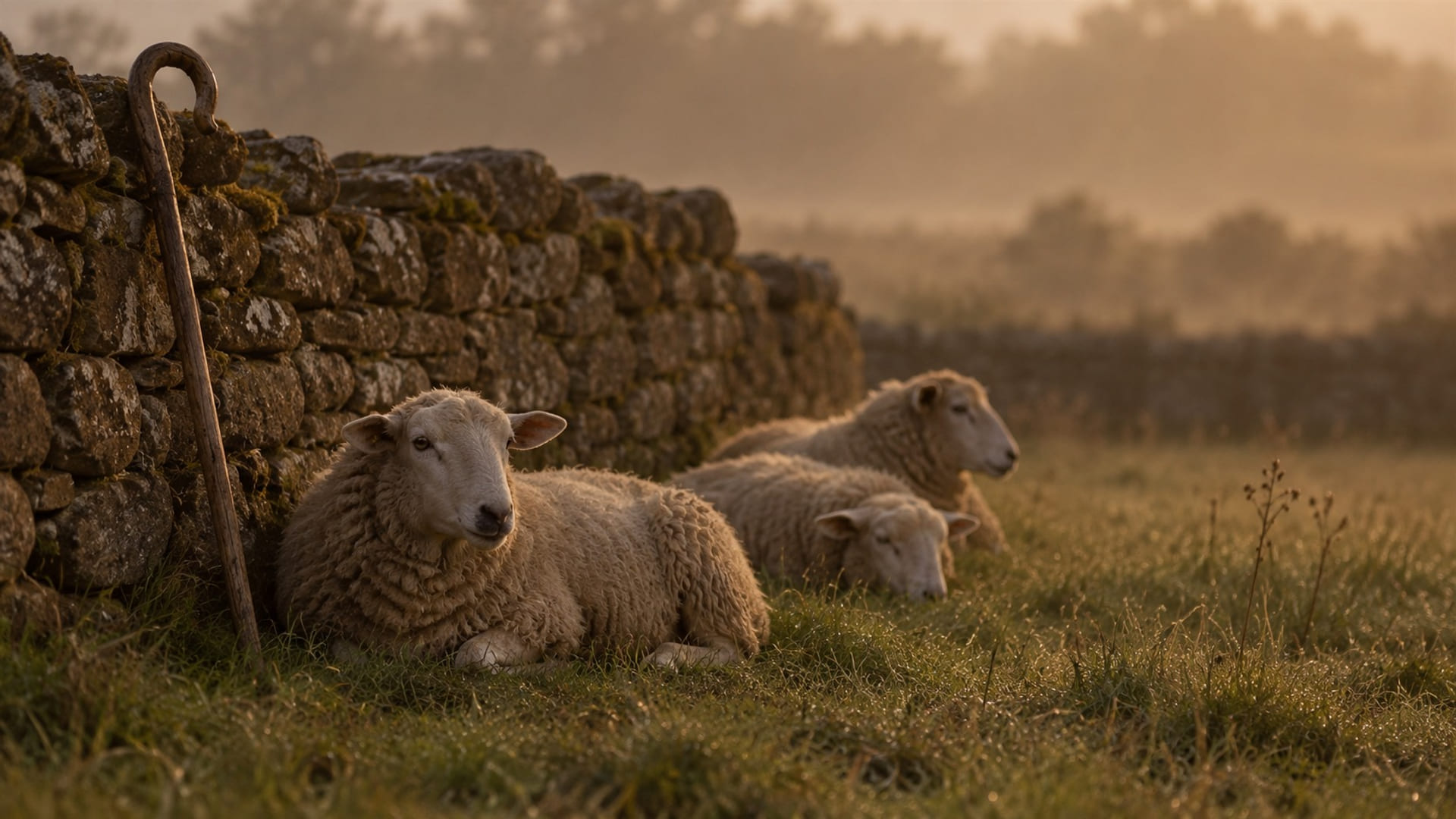
Rachel is the Hebrew name Rahel, and it means "ewe," a female sheep (Strong's H7353, Brown-Driver-Briggs). Genesis 29:9 explains the sheep: “Rachel came with her father’s sheep, for she kept them.” Baby-name sites add gentle and pure as associations. The National Hurricane Center says RAY-chull, Hebrew is rah-KHEL, and Spanish Raquel (also the Reina-Valera 1909 spelling) is ra-KEL, stressed on the last syllable.
Her place today is layered. Chabad remembers "Rachel Imenu," Rachel our mother, who prays for her children. The Jewish Women's Archive describes a matriarch whose story holds love, rivalry, infertility, motherhood and mourning. The Catholic Encyclopedia reads her place in Jeremiah and Matthew, and the Protestant commentator Matthew Henry dwells on Jacob's love for her.
If you only have a minute
The name
Rahel, "ewe"; Rachael is an English spelling variant.
The woman
Shepherdess, Jacob's wife, and the mother who weeps in Jeremiah 31:15.
For a heavy night
The storm, and where to follow it
The National Hurricane Center's Eastern Pacific season table lists Rachel as forming on September 27, 2026, and its discussion for Advisory 13, issued 2:00 AM MST on Wednesday, September 30, already calls it Hurricane Rachel, and the last advisory in the archive is Advisory 24, issued 8:00 PM MST on Friday, October 2. The advisories described dangerous waves and swells along parts of the west-central coast of Mexico and the Baja California Peninsula, and tropical-storm-force winds along parts of Mexico's coast, and the AP reported on the storm on October 3.
- National Hurricane Center: English, Español
- National Weather Service: weather.gov
- Ready.gov hurricanes: English, Español
- American Red Cross: hurricanes, Cruz Roja Americana
- Mexico: Servicio Meteorológico Nacional, Protección Civil
The national weather service for your own country is the one to follow.
Rachel at the well
Her story begins at a well. Jacob arrives in the land of the east as Rachel brings her father's sheep to the well. He offers seven years of service for her: “They seemed to him but a few days, for the love he had for her.” Laban gives Leah at the wedding feast, and Jacob serves seven more years for Rachel. Later she hides her father's household gods (31:19-35). Waiting for a spouse uses Genesis 29:20, feeling left out tells Leah's side, and Leah's name tells her in full.
The long wait for a child
Rachel sees she has borne Jacob no children and says, “Give me children, or else I will die.” Jacob answers, “Am I in God’s place, who has withheld from you the fruit of the womb?” Bilhah bears Dan and Naphtali, and the sisters bargain over mandrakes. Then “God remembered Rachel, and God listened to her, and opened her womb.” She names her son Joseph, saying “God has taken away my reproach,” and Joseph comes from a root meaning "add." Jewish commentators read "reproach" as the shame childlessness carried then, and the story treats her longing with sympathy. Bible verses for infertility quotes Genesis 30:1 beside Hannah.
Benjamin's birth and Rachel's death
Near Ephrath, Rachel has hard labor, and the midwife says, “Don’t be afraid, for now you will have another son.” Rachel names him Benoni and Jacob names him Benjamin; she is buried “on the way to Ephrath (also called Bethlehem),” where Jacob sets up a pillar (Genesis 35:16-20). Brown-Driver-Briggs gives Ben-oni as "son of my sorrow" and Benjamin as "son of the right hand." First Samuel 10:2 speaks of “Rachel’s tomb, on the border of Benjamin.” The traditional Rachel's Tomb lies north of Bethlehem on the old road to Jerusalem (Jewish Encyclopedia, Catholic Encyclopedia), and Jewish, Christian and Muslim traditions have each honored it. Confirm access conditions with the visitor authority at the site before you travel.
Psalm 34:18, for a loss
For the grief in Rachel's story, Psalm 34:18:
Yahweh is near to those who have a broken heart, and saves those who have a crushed spirit.
The King James reads, "The LORD is nigh unto them that are of a broken heart." Psalm 34 is a song of praise formed in hardship, holding suffering and God's attentive presence together; verses 17 and 19 speak of deliverance on either side, and the psalm gives no timescale. Verse 18 offers nearness in the present tense to people whose hearts are broken, without explaining the loss or hurrying it. The Hebrew phrases are nishberei-lev, a broken heart, and dakkei-ruach, a crushed spirit (lev, dakka), and Matthew Henry reads the broken heart as people humbled and distressed before God. Read it aloud once with the name of the one you are grieving, and hold one question: what would it mean to let nearness, rather than explanation, be enough today? Psalm 34:18 with the verses around it; grief and healing reads it at more length.
The mother who weeps
Jeremiah 31:15 gives Rachel a voice:
Yahweh says: “A voice is heard in Ramah, lamentation and bitter weeping, Rachel weeping for her children. She refuses to be comforted for her children, because they are no more.”
Ramah lay in Benjamin's territory, "her children" are the exiles of Israel, and Rachel is a poetic figure for the mothers of Israel. Rashi and the Rosh Hashanah haftarah keep the passage in exile and return, and verses 16 and 17, “Refrain your voice from weeping” and “They will come again from the land of the enemy,” answer a weeping in that exile. Matthew 2:13-18 quotes the lament after Herod's killing of the children of Bethlehem, and Christian readings differ on how; Catholics remember the Holy Innocents on December 28. The Bible gives a mother's grief a voice and records that she refused to be comforted, and lets that grief stand. Loss of a child and tragedy read these verses; Jeremiah 31:15 and Matthew 2:18 show them in place.

If you carry infertility or the loss of a baby
The World Health Organization said on April 4, 2023 that around 17.5 percent of adults, about one in six, experience infertility in their lifetime. The NHS says about one in eight pregnancies that people know about ends in miscarriage, and Tommy's says about one in four counting pregnancies before they are recognized, two different groups. These are numbers about groups, not reasons or faults. Some kind sayings land hard; gentler lines that help:
- Instead of "everything happens for a reason," try "I'm so sorry. I'm here, and I'm not going anywhere."
- Instead of "you can try again," try "I know this baby mattered."
- Instead of "she is in a better place," try "I wish she was here, too."
- Instead of "pray harder," try "I'm praying with you tonight, and bringing dinner on Thursday."
Support for a loss or for infertility:
- United Kingdom: Miscarriage Association, Tommy's, Sands
- United States: March of Dimes, Share Pregnancy and Infant Loss Support, RESOLVE for infertility
- Canada: Pregnancy and Infant Loss Support Centre
- Australia: Miscarriage Australia, Sands Australia, Pregnancy, Birth and Baby on 1800 882 436
- Ireland: Miscarriage Association of Ireland, Féileacáin
If the storm's name makes you wonder
Wondering is ordinary. The NHC says storm names come from lists chosen and approved in advance, and the WMO lists Rachel on its 2026 list, one of six in rotation, set years ahead and not for an event. Luke 13:1-5 has Jesus declining to read a disaster as proof that its victims were worse sinners, and Matthew 5:45 says the sun rises and the rain falls on the evil and the good. Traditions differ on how God relates to storms and other natural events.
Other names on the 2026 storm lists with a story in the Bible: Isaias, Simon, Josephine, Leah, Marco, Omar, Paulette, Sally and Zeke.
Questions from Spanish-speaking readers
¿Qué significado tiene el nombre Raquel? Spanish name dictionaries usually give oveja or corderita, matching the Hebrew "ewe"; tenderness and devotion are popular naming lore.
¿Qué significa Raquel en el amor? Jacob loved Rachel and served seven years for her; the story also holds Laban's deception and the sisters' rivalry.
Raquel y Lea en la Biblia: sisters, daughters of Labán, both wives of Jacob.
¿Qué significa Rebeca? A different name, Rivqah, "to bind," derivation uncertain (Strong's H7259). For frequency, see Spain's INE and the SSA, which lists Rachel and Rachael separately. Spanish Bibles list her story at Génesis 29, 30 and 35, Jeremías 31:15 and Mateo 2:18.
For any night that feels too heavy
For any night that feels too heavy, whatever the cause: in the United States, call or text 988, and for Spanish text AYUDA to 988. In Canada, call or text 9-8-8. In the United Kingdom and Ireland, Samaritans is on 116 123. In Australia, Lifeline is 13 11 14. Anywhere else, Find A Helpline lists lines by country.
Tonight, say the name of someone you are thinking of, read Psalm 34:18 once aloud, and if the storm is near you, open the National Hurricane Center page for your area. Bible Nudge can take a line in your own words. Find a passage.
Words that come up here
Tap a term to see what it means.
Rahel. The Hebrew form of Rachel, meaning "ewe."