

One person, writing on Reddit's r/Christianity after children were killed, put it plainly: "You can't tell me those kids didn't pray." A few lines later they wrote, "I don't understand why. Maybe it's not for me to understand." Below are the days after in order: tonight, the gathering, the question why and the weeks after, with help for speaking to a group or writing a message.
If you only have a minute
Read tonight
Psalm 34:17-19, aloud if you can, alone or with others.
Standing up tomorrow
One plain sentence, one reading, who to talk to, a minute of quiet.
If you are struggling
In the United States, the Disaster Distress Helpline, 1-800-985-5990; other countries are at the end.
Tonight: Psalm 34:17-19
Bible Nudge offers Psalm 34:18 for grief, with the verse on either side:
17 The righteous cry, and Yahweh hears, and delivers them out of all their troubles. 18 Yahweh is near to those who have a broken heart, and saves those who have a crushed spirit. 19 Many are the afflictions of the righteous, but Yahweh delivers him out of them all.
Nearness comes now, in verse 18, with rescue named on either side in verses 17 and 19. The verse is plural, about "those" with a broken heart, so it can be read over a room as easily as over one. Read verses 17 to 19 aloud tonight, and stay with one question: what would it mean to let nearness, rather than explanation, be enough today? The post on sudden death reads verse 18 for the first hours after a single loss.
If you lost nobody and still cannot stop scrolling
The US National Center for PTSD says "Many people directly experience the event and many more witness or are indirectly affected by the disaster," and lists shock, fear, helplessness, guilt, numbness, grief and nightmares among the possible reactions.
In a US national sample of 2,189 people after one national tragedy, four or more hours a day of early television coverage was associated with more health problems two to three years later (Silver and colleagues, *Psychological Science*, 2013). After another attack, six or more daily hours of coverage was associated with higher acute stress than being there (Holman, Garfin and Silver, *PNAS*, 2014). Both are associations in those samples. Tonight, read one psalm, then put the phone face down.

One psalm, and then the phone can rest.
A whole book for a city in grief
Lamentations opens, "How the city sits solitary, that was full of people! She has become as a widow." Chabad, the Jewish educational site, calls it Jeremiah's prophecy of the First Temple's destruction, read on Tisha B'Av and largely structured by the Hebrew alphabet. At verse 12 the city speaks to passers-by:
Is it nothing to you, all you who pass by? Look, and see if there is any sorrow like my sorrow.
At verse 16 she says, "For these things I weep. My eye, my eye runs down with water, because the comforter who should refresh my soul is far from me." It gives words for grief that belongs to a whole place, and a line for everyone driving past the flowers. The post on suffering reads chapter 3.
Praying as "we"
Some psalms pray in the plural, and they suit a room full of people. Psalm 44 speaks for a people who say "we have not forgotten you," then "Wake up! Why do you sleep, Lord?" and "Rise up to help us." Psalm 79 asks "How long, Yahweh?" over a ruined city and its unburied dead. Matthew Henry, from the Reformed tradition, reads Psalm 44 as the complaint of God's people under affliction who still resolve to cleave to God. They give a prayer said together that asks the hard question aloud.
Scripture also shows mourning shared out on purpose. In Jeremiah 9 the people are told to call for "the mourning women" and "skillful women" to "take up a wailing for us." Joel 2 gathers elders and children to a solemn assembly while the priests weep for them. Zechariah 12 has "a great mourning in Jerusalem," every family apart. Paul tells the church at Corinth, "When one member suffers, all the members suffer with it." In each, some people carry the words for the rest. The Catholic Catechism calls solidarity "a direct demand of human and Christian brotherhood" (1939).
If you have to stand up in front of a group tomorrow
The World Health Organization's Psychological First Aid guide (2011) describes "humane, supportive and practical help" after serious crisis events. For schools, the National Child Traumatic Stress Network's tips for educators say students may "Feel sad, scared, empty, or numb," may feel school is unsafe or fear it will happen again, and will not all react the same way. Its sheet on talking to children covers "common reactions children may have."
A shape that asks little of a frightened room: say what happened in one plain sentence, read Psalm 34:17-19 or Lamentations 1:12, name who they can talk to this week, and leave a minute of quiet.
If a death by suicide is part of what happened, the WHO and IASP guidance for anyone speaking publicly says "Do provide accurate information about where to seek help for suicidal thoughts and suicidal crises," and "Don’t describe the method used."
Readings for a vigil or a service
Hover or tap a row to highlight it. Sort by a column heading; a third click puts the rows back in their original order.
| Psalm 34:17-19 | A psalmist, of "those" with a broken heart | Opening |
| Lamentations 1:12 | The grieving city | After names are read |
| Psalm 44:23-26 | A whole people, as "we" | A prayer said together |
| Matthew 2:18 | Rachel, weeping for her children | Where children died |
The Roman Missal, among its Masses for various needs, prays "Almighty and eternal God, our refuge in every danger, to whom we turn in our distress." Jewish communities read Lamentations and the kinot, the elegies, on Tisha B'Av. Any gathering can borrow these words.
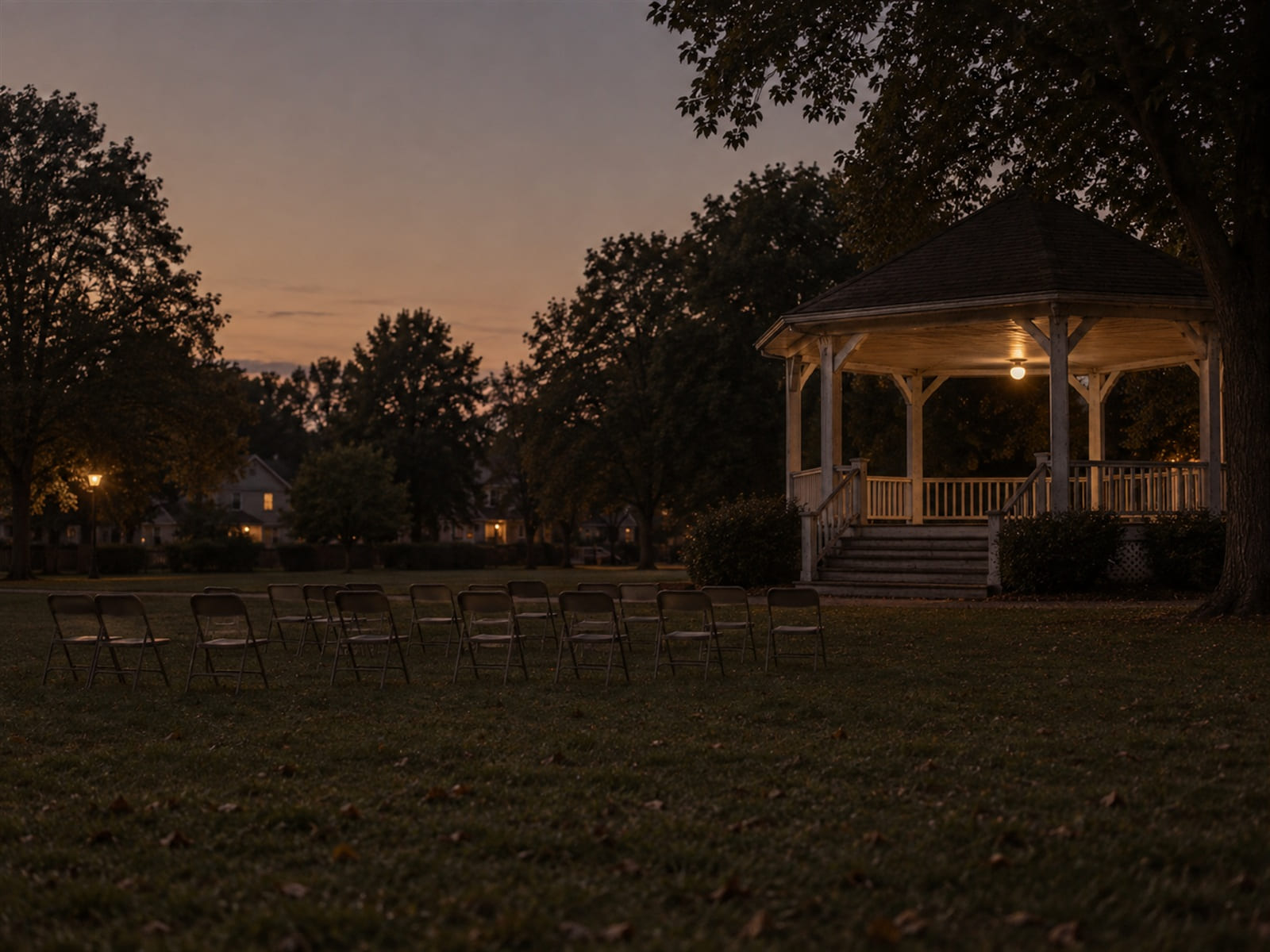
Set out before anyone arrives.
Writing a message to a grieving community
People disagree sharply about "thoughts and prayers." One person wrote on Reddit's r/PoliticalHumor, "“Thoughts and prayers” infuriated me as a religious person." Another Reddit user, on r/christianmemes, put it differently: "We pray on it and then work on it."
A message that holds both names the people and the place you are praying for and one thing you are doing: a meal, a donation, turning up. Our post on sympathy cards reads Romans 12:15, "Weep with those who weep."
When children are among the dead
Matthew records the killing of the young children of Bethlehem as Herod's act and quotes Jeremiah: "Rachel weeping for her children; she wouldn’t be comforted, because they are no more." Matthew Henry reads Rachel as the mothers of Bethlehem mourning together. For a town that has lost children, the plural stands, and the grief is allowed to be as large as it is. Jeremiah 31:15-17 is read closely in loss of a child.
The question why
Scripture keeps the question. Psalm 10:1 asks, "Why do you stand far off, Yahweh? Why do you hide yourself in times of trouble?" Habakkuk says to God's face, "Yahweh, how long will I cry, and you will not hear?" and names violence as he says it.
Traditions answer differently. The Catholic Catechism asks, if God "cares for all his creatures, why does evil exist?" and says no quick answer will do (309). John Calvin, Reformed, reads Luke 13 as Christ correcting the habit of judging people struck by calamity as worse than others, while calling every hearer to repent. The Church of England's 1662 prayer book kept a prayer in time of plague that speaks of God who "in thy wrath didst send a plague," a historic text for its own time. The three stand side by side. Sudden death reads Luke 13:1-5, where a tower fell.
Psalms 46 and 91
These are the psalms most often posted after a tragedy. Psalm 46 opens, "God is our refuge and strength, a very present help in trouble," over mountains shaken and waters roaring. Matthew Henry reads it as trust in God's power and presence with his people through the worst of times. The post on stress reads it slowly.
Psalm 91 says, "A thousand may fall at your side," and families who lost somebody faithful will read it closely. Charles Spurgeon, in *The Treasury of David*, reads its promises first as safety in fellowship with God, and applies them to bodily harm only in part. The Catholic Catechism treats death as part of every human life, faithful lives included (1006). Both are here, side by side.
The weeks after
When the flowers are cleared and the news moves on, the National Center for PTSD describes an early "altruistic or therapeutic community" often followed by disillusionment, a pattern, not a rule. It says "Almost everyone will experience stress reactions in the aftermath of disaster events," and that for most "these reactions will gradually decrease over time." Its self-care page adds, "If you are distressed, or unable to function well, consider seeking help." A family doctor, called a GP in the UK, is a good first call.
A month on, message or visit the family, teacher or colleague still carrying it.
Questions people ask
What if the children I teach ask about it? The NCTSN sheet on talking to children has tips for starting that conversation and seeking help.
Is it all right to say "How long?" to God? Psalm 79 and Habakkuk both do, in Scripture itself, and a gathering can say it with them.
Where to go next
If you are struggling, in the United States the Disaster Distress Helpline takes calls and texts on 1-800-985-5990, and 988 is the Suicide and Crisis Lifeline. In Canada, call or text 9-8-8. In the UK and Ireland, Samaritans is on 116 123. In Australia, Lifeline is 13 11 14. Anywhere else, Find A Helpline lists lines by country.
One next step: read Psalm 34:17-19 aloud once, alone or with others. For something else you are carrying, Bible Nudge takes a line in your own words and offers one passage with the verses around it. Find a passage.
Words that come up here
Tap a term to see what it means.
Tisha B'Av. A Jewish fast day mourning the destruction of the Temples in Jerusalem, when Lamentations is read.