


Josephine comes from a Bible name. It is the feminine form of Joseph, first shaped in French as Joséphine, and its root is the Hebrew Yosef, the name of Jacob's son and of Mary's husband. Etymonline gives "fem. proper name, from French Jósephine, fem. of Joseph," and Behind the Name calls it the "English, German and Dutch form of Joséphine," beside Josefina in Spanish and Portuguese, Giuseppina in Italian and Josefine in German. The National Hurricane Center's 2026 pronunciation guide gives JOH-seh-feen; it is zho-zay-FEEN in French and ho-seh-FEE-na in Spanish.
The Library of Congress says Napoleon's first wife, born Marie Josèphe Rose Tascher de La Pagerie, was given the name Joséphine by him, which helped carry the name across Europe. Is Josephine a biblical name for Catholics? The Catechism, 2156 says in baptism "the Christian receives his name in the Church," and that the name can be a saint's or can "express a Christian mystery or Christian virtue." Families choose names in many ways, and a person of any faith or none carries Josephine as fully as anyone.
If you only have a minute
The answer
Josephine is the French feminine of Joseph, and Joseph is Hebrew.
The meaning
Yosef, "he adds," from Genesis 30:24.
The Josephs
Jacob's son, Mary's husband, and several others.
To read aloud
Romans 15:13, once.
Yosef, "he adds"
Brown-Driver-Briggs ties Yosef to the verb yasaph, "to add," Strong's H3130 derives it from H3254, "to add," and the fuller form Yehoseph is glossed "Jehovah adds" (Strong's H3084). Genesis 30:22-24 gives the story, where Rachel, after years of waiting for a child, names her son:
God remembered Rachel, and God listened to her, and opened her womb. She conceived, bore a son, and said, “God has taken away my reproach.” She named him Joseph, saying, “May Yahweh add another son to me.”
The King James Version has "The LORD shall add to me another son." The text plays on two Hebrew roots, asaph, "take away," and yasaph, "add." "God adds" is the common devotional gloss on that. Rachel's story is told in Rachel's name in the Bible.
Joseph, son of Jacob
At seventeen Joseph is his father's favorite, in a special tunic, and tells dreams in which his family bows to him. His brothers say, "Behold, this dreamer comes" (Genesis 37:19), in Hebrew ba'al hachalomot, "lord of dreams," said in contempt. They throw him in a pit and sell him, and he arrives in Egypt. In Potiphar's house "Yahweh was with Joseph" (Genesis 39:2); Potiphar's wife accuses him, and he goes to prison. Then come Pharaoh's dreams, his authority over the grain, and the day he tells his brothers, "I am Joseph, your brother, whom you sold into Egypt" (Genesis 45:4). Rashi on Sefaria reads the brothers' words as contempt, and Matthew Henry and Enduring Word also comment on the chapter. The pages on regret, estranged family and losing a job each read part of this story.

Hung up and waiting.
The brothers, and the verse people quote
Genesis 50:20, in the World English Bible: "you meant evil against me, but God meant it for good." The King James Version has "ye thought evil against me; but God meant it unto good," and the Jewish Publication Society translation on Sefaria uses "intended." The Hebrew verb chashav, to think, plan or intend, is used for both the brothers and God. Calvin reads the verse as providence while keeping the brothers' guilt, but some survivor communities reject using it to tell a harmed person the harm was for good. A poster on Reddit's r/raisedbynarcissists, in a thread posted January 7, 2022, described being told "everything’s happens for a reason and I’m sure your parents had your best interest at heart," and wrote of it, "Its inconsiderate and harsh. Just be with me in my pain."
Forgiving and reconciling are two different things. The story records Joseph's refusal to retaliate, his provision for his family and the reunion. You may forgive or not, reconcile or not, and a harmed person need not return to an unsafe relationship. A gentler line for a friend: "I'm sorry that happened. I'm here, and you don't have to explain it to me."
Romans 15:13, a connection to Joseph's waiting
For the long waits in Joseph's story, Romans 15:13. Paul closes a call to a patient, welcoming community, building on Deuteronomy 32:43, Psalm 117:1 and Isaiah 11:10:
Now may the God of hope fill you with all joy and peace in believing, that you may abound in hope, in the power of the Holy Spirit.
The King James Version has "through the power of the Holy Ghost." Verses 10 to 12 before it quote the Gentiles rejoicing and hoping. It phrases hope as a prayer, something received rather than produced, which gives words to a person who cannot make themselves hopeful. The Greek word is elpis, and Matthew Henry and Enduring Word read verse 13 as a prayer. Joseph's story describes waiting in its own words: the cupbearer "didn’t remember Joseph, but forgot him" (Genesis 40:23), and his sons' names mark forgetting toil and fruitfulness in affliction (41:51-52). Where do you most need hope to be given rather than generated? Read Romans 15:13 with the verses around it, and hope in hard times goes further.
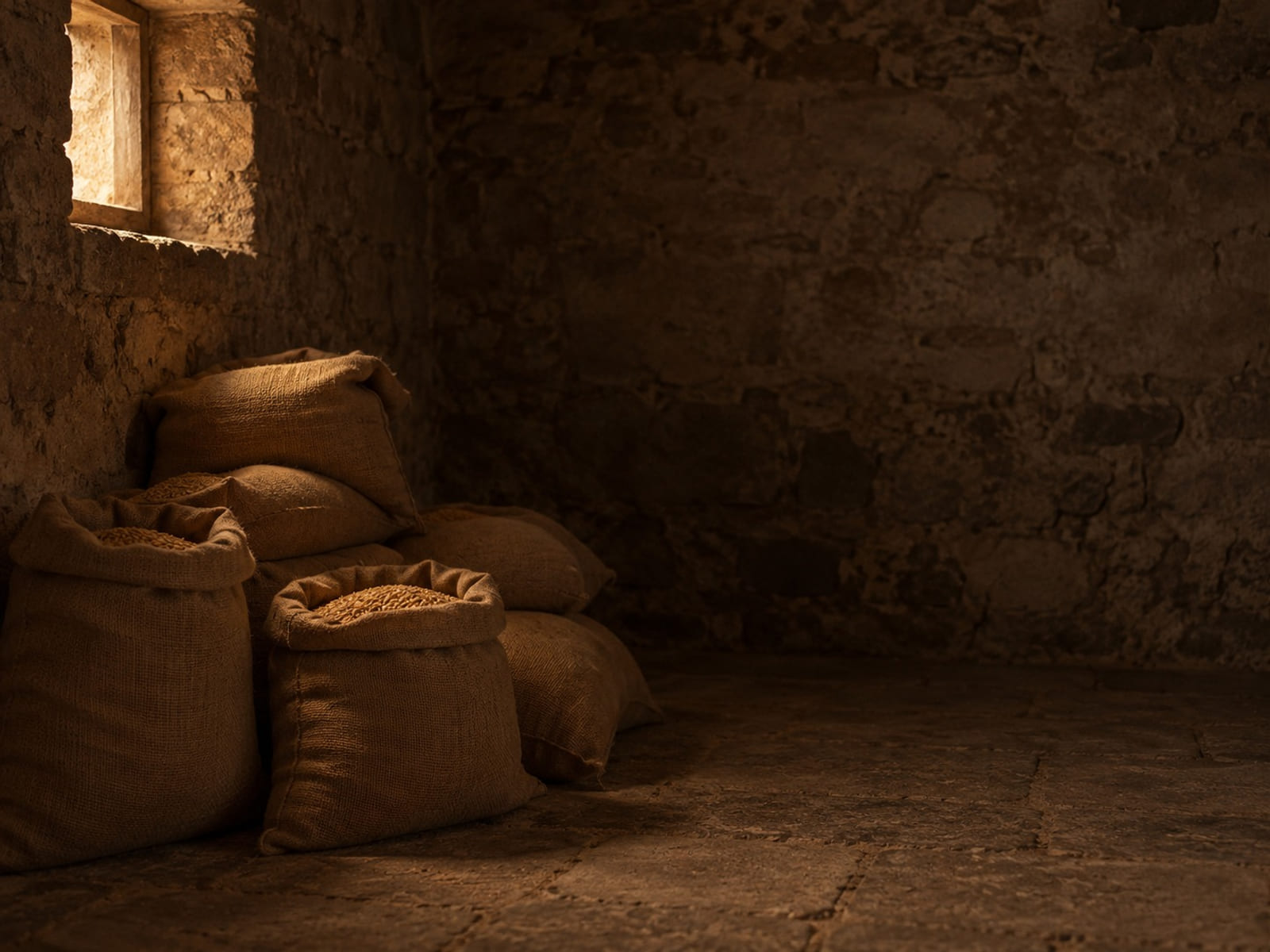
Grain, stored.
The other Josephs
Joseph of Nazareth: Matthew 1:19 calls him a righteous man, and he takes Mary and Jesus to Egypt after an angelic warning (Matthew 2:13-23); the Gospels record none of his words. Pope Francis's Patris Corde calls him "a beloved, tender and loving, obedient, accepting, creatively courageous, working father in the shadows." The Church keeps his feast on March 19, and Orthodox churches remember Joseph the Betrothed on the Sunday after the Nativity. Keep these apart:
- Joseph of Arimathea asks for Jesus' body (Matthew 27:57-60, Luke 23:50-53).
- Joseph called Barsabbas (Acts 1:23).
- Joseph called Barnabas by the apostles (Acts 4:36-37).
- Joses or Joseph among the brothers of Jesus (Mark 6:3, Matthew 13:55).
Saint Josephine Bakhita
Vatican News and the Canossian Sisters say she was born around 1869 in a village in Darfur, in present-day Sudan, was enslaved as a child, came to Italy and gained her freedom, became a Canossian sister, and died in Schio on February 8, 1947. Pope John Paul II canonized her on October 1, 2000. Her feast is February 8, the day the Church pairs with prayer and awareness against human trafficking, and Vatican News describes her as a patron of people affected by trafficking.
Josefina, in Spanish
¿Es Josefina un nombre bíblico? Josefina is the feminine form tied to José, who does appear. ¿Qué significa Josefina en la Biblia? It inherits the sense of adding or increasing, and name pages gloss it "Dios añadirá" or "Dios acrecienta," which are interpretive. ¿Josefina es hebreo? The root is Hebrew and the form is Spanish. The Reina-Valera 1909 spells Joseph José in Génesis 30:22-24, 37, 39, 45 and 50, and Mateo 1 and 2. Short forms are Pepe, Pepito, Chepe and Joselito for José, and Pepa, Pepi, Pepita, Fina and Finita for Josefa and Josefina; the saints are San José and Santa Josefina Bakhita. Spain's INE name tool shows how common each name is.
On Reddit's r/namenerds, one parent wrote in a thread posted February 18, 2021, "I have also always loved the name Josephine ever since I was young and always imagined having a daughter with that name." On r/Catholicism, a commenter in a thread posted July 31, 2023 wrote, "You do not have to take a saint’s name for Confirmation. The name only has to be a Christian name."
A name on a list
Josephine is on the published 2026 Atlantic hurricane name list. The National Hurricane Center describes it as one of six lists used in rotation and "re-cycled every six years, i.e., the 2026 list will be used again in 2032," with names from English, Spanish and French. Names are set years ahead, and people who read events through Scripture hold a range of views on providence. Wondering is allowed.
Other names on the 2026 storm lists with a story in the Bible: Isaias, Rachel, Simon, Leah, Marco, Omar, Paulette, Sally and Zeke.
For your own nights
For any heavy night: in the United States, call or text 988. In Canada, call or text 9-8-8. In the United Kingdom and Ireland, Samaritans is on 116 123. In Australia, Lifeline is 13 11 14. Anywhere else, Find A Helpline lists services by country. If you recognize trafficking or coercion in your own life: in the United States, the National Human Trafficking Hotline is 1-888-373-7888 or text 233733; in the United Kingdom, the Modern Slavery Helpline is 08000 121 700; in Canada, the Canadian Human Trafficking Hotline is 1-833-900-1010; in Australia, the Australian Federal Police, and 000 in an emergency.
Tell one person the story behind a name, or read Romans 15:13 once, aloud. Bible Nudge can find a passage for you: Find a passage.
Words that come up here
Tap a term to see what it means.
Yosef. The Hebrew form of Joseph, linked to a verb meaning "to add."