


If your husband or wife is not a believer, the Bible speaks to your marriage directly. Paul wrote to new believers in Corinth who were married to spouses who had not joined them, and he told them not to leave a husband or wife who is content to stay. He called the unbelieving spouse "sanctified" in the believing one, and their children "holy" (1 Corinthians 7:12-14).
The marriage you are in is a marriage. The person you share it with is a husband or wife you love, not a problem to be solved, and everything below is written with that person in mind as well as you.
If your spouse controls, threatens or frightens you, the National Domestic Violence Hotline in the United States is there by call (800-799-SAFE), chat, or text START to 88788, and the Christian voices that teach submission and those that reject it agree that it never means accepting abuse. If the loneliness of it is the hardest part, Bible verses for loneliness in marriage stays with that at length.
If you only have a minute
The short answer
Paul told believers married to unbelievers to stay when their spouse is content to stay.
If you are afraid at home
The Hotline and the routes by country further down come before any verse.
Words to pray
Psalm 25:16-17 is a short prayer you can say on the way home from church.
One thing to keep
A meal, a walk or a holiday tradition can ask no belief of either of you.
Is it okay to live with an unbelieving husband or wife?
Yes, and Paul says so to people in exactly your place. 1 Corinthians 7 is a chapter of answers to questions the Corinthians had written to him, about marriage, singleness, slavery and how to live under the pressures of their time. In it Paul marks a command he attributes to "the Lord" (7:10) off from his own instruction, which begins "To the rest I say, not the Lord" (7:12). Then he turns to the believer married to someone who does not believe. In the World English Bible, a modern English translation:
To the rest I say, not the Lord: if any brother has an unbelieving wife, and she is content to live with him, let him not leave her. The woman who has an unbelieving husband, and he is content to live with her, let her not leave her husband. For the unbelieving husband is sanctified in the wife, and the unbelieving wife is sanctified in the brother. Otherwise your children would be unclean, but now they are holy. Yet if the unbeliever separates himself, let him separate himself. The brother or the sister isn’t under bondage in such cases, but God has called us in peace. For how do you know, wife, whether you will save your husband? Or how do you know, husband, whether you will save your wife?
The King James Version, which many people learned first, puts the opening this way:
If any brother hath a wife that believeth not, and she be pleased to dwell with him, let him not put her away.
Notice that the passage speaks to believing wives and believing husbands alike, in matching sentences. The Greek words carry the shape of it: suneudokeō, to consent or be pleased with, for the spouse who is content to stay; hagiazō, to sanctify or make holy; eirēnē, peace; and sōzō, save. Verse 15 speaks to a different situation, a spouse who chooses to leave.
Verse 16 is read two ways. The Catholic Catechism, at paragraph 1637, speaks of the Christian spouse's particular task in the marriage and of the other spouse's free conversion as a possible joy. Reformed and evangelical readers tend to hear Paul's question as honest uncertainty: how do you know? Both readings leave your spouse's faith with God and with your spouse.
There is a family like yours in the Bible's own pages. Timothy, who traveled with Paul, had a Jewish mother who believed and a Greek father (Acts 16:1-3), and his mother Eunice and grandmother Lois are named for their sincere faith (2 Timothy 1:5).

Some people sit here a while before driving home.
People also ask whether they can divorce a non-believer, or whether God expects them to stay in an unhappy marriage. Published Christian writers mostly read 1 Corinthians 7 as telling the believer not to begin a separation because of belief, and they part ways where abuse is present, where many say safety comes first. In Catholic canon law, the Pauline privilege (canons 1143 to 1147) is a rule for a marriage of two unbaptized people when one is later baptized and the other departs. If the question is live for you, take it to a pastor or priest who knows the whole story, and tell them all of it.
Is it a sin to marry someone who is not a Christian?
You are already married, so start there. The passage written to people already married tells the believer to stay, calls the unbelieving spouse sanctified and calls the children holy. It treats your marriage as a marriage and your home as a household made holy. Hold that before the verse you may have had quoted at you.
That verse is 2 Corinthians 6:14. In the World English Bible:
Don’t be unequally yoked with unbelievers, for what fellowship have righteousness and iniquity? Or what fellowship has light with darkness?
The phrase people know comes from the King James: "Be ye not unequally yoked together with unbelievers." It sits inside Paul's warm appeal to the Corinthians, which opens "Our mouth is open to you," and runs through a passage about the temple of God and idols. Commentators read it in three main ways: as about pagan worship and temple feasts, as about close partnerships in general, or as about marriage. Enduring Word and Matthew Henry both comment on the passage. Evangelical writers mostly apply it to choosing whom to marry, before the wedding, rather than to a marriage already made.
The Greek verb is heterozugeō, to yoke with a different kind. It looks back to a farming law in Deuteronomy 22:10: "You shall not plow with an ox and a donkey together." Sefaria has the verse with the Jewish commentary around it, which mostly reads it as about animals of unequal strength or kind.
If you have searched for "forbidden marriage in the Bible," you will meet Deuteronomy 7:1-4, Ezra 9:1 to 10:5 and Nehemiah 13:23-27. Each gives worship as its reason: the fear that a marriage would turn Israel's sons and daughters toward other gods. Beside them stands Ruth, a Moabite, who said to her mother-in-law, "Your people will be my people, and your God my God" (Ruth 1:16-17), and who stands in the family line of King David (Ruth 4:13-22). Moses married Zipporah, the daughter of Reuel (Exodus 2:21), and Numbers 12:1 mentions his Cushite wife. Some readers reconcile these by saying the bans were about idolatry rather than ancestry, with Ruth as a model of joining Israel's God; others read the reforms of Ezra more strictly. Both readings are held by serious people.
You may be asking a quieter question too: will God forgive me for marrying an unbeliever? Published Christian writers answer in three ways. Some call marrying a non-Christian unwise or disobedient. Some separate entering a marriage from remaining in one, and say the second is what 1 Corinthians 7 addresses. Some say plainly that God forgives a person who married an unbeliever. Whichever you have heard, the instruction to you, today, in the passage written for your situation, is to stay with a spouse who is content to stay.
Should a wife submit to an unbelieving husband?
Start with the text itself. In the World English Bible, 1 Peter 3:1-2 reads:
In the same way, wives, be in subjection to your own husbands; so that, even if any don’t obey the Word, they may be won by the behavior of their wives without a word, seeing your pure behavior in fear.
And verse 7, a few lines on:
You husbands, in the same way, live with your wives according to knowledge, giving honor to the woman as to the weaker vessel, as being also joint heirs of the grace of life, that your prayers may not be hindered.
Then the setting. 1 Peter is a letter to believers who were a small minority in the Roman empire. In 2:18-25 it speaks to servants, and then it turns to wives whose husbands did not share their faith, in a patriarchal household of its own time. The Greek hypotassō means to place under or to submit, and aneu logou is "without a word," conduct in place of argument. Verse 7 calls wives joint heirs of grace with their husbands, and if you are a husband asking the same question about your wife, that is the verse written to you.
Then the readings. They differ, and they meet on one point. The PCA women's ministry, which keeps the language of submission, distinguishes it from obeying sin or accepting abuse. Christians for Biblical Equality reads the passage as a household text of its time that cannot be used to require submission to abuse. Bible verses for loneliness in marriage already gives the Danvers Statement, the US Catholic bishops and canon 1153 on this, if you want their words.
Then the routes, each for its own country. In the United States, the National Domestic Violence Hotline is on 800-799-SAFE, by chat, or by texting START to 88788. In the United Kingdom, Refuge runs the National Domestic Abuse Helpline on 0808 2000 247. In Australia, 1800RESPECT is there. In Canada, ShelterSafe is a Canada-wide directory of shelters and crisis services.
In Spain, the 016 line serves people facing gender violence. In Mexico, the Red Nacional de Refugios is the national network of shelters, and in Argentina, Línea 144 answers. Anybody in danger right now calls the local emergency number first.
What to do when your spouse doesn't believe in God
Christian writers and the people who work with couples like yours tend to say similar things, with different weight. Focus on the Family's "My Husband Is Not a Christian" puts its weight on respectful conduct, prayer, patience and avoiding constant pressure. Dr. Carol Ministries writes about honest communication, prayer and boundaries around faith practice, so each of you knows what the other needs.
The Catholic marriage ministry For Your Marriage stresses respect for the spouse's conscience, prayer, and the Catholic spouse living the faith in ordinary days. For homes where two traditions meet, InterfaithFamily and the Dovetail Institute for Interfaith Family Resources write about holidays, extended family, children and household rituals, and they treat shared values and respectful practice as places to meet without shared belief.
People living in these marriages describe a wide range. Some go to church alone every week. Some have a spouse who comes along at Christmas. Some married a fellow believer who changed belief after the wedding, and some came to faith themselves after the wedding while their spouse did not. A common thread in their accounts is prayer turning into pressure once the spouse begins to feel treated as a project. These are individual experiences and they vary widely, so take what fits and leave the rest.

The ordinary mornings belong to both of you.
A few ideas of our own, for whatever they are worth to you. Pray for your spouse without reporting the prayers to them; the prayer can be yours and God's. Tell them, in a sentence, what your faith means to you, and ask them, in a sentence, what they value most, then listen to the answer without steering it. And keep one shared ritual that asks no belief of either of you: a Saturday meal, an evening walk, a holiday tradition that is simply yours.
You have plenty of company. Pew Research Center reported in 2015 that among Americans married since 2010, 39 percent had a spouse from a different religious group.
Church alone on Sunday, and children in a two-faith home
Each tradition has its own rule for this, in its own words, and each asks something particular of the believing parent. Which parent's faith the children follow is a decision for your family. Two Catholic terms come up first: a mixed marriage is a Catholic married to a baptized Christian of another church, and disparity of cult is a Catholic married to someone who is not baptized.
Hover or tap a row to highlight it. Sort by a column heading; a third click puts the rows back in their original order.
| Catholic | The Catholic party declares a willingness to preserve the faith and to do what is possible for the children to be baptized and brought up Catholic; the other spouse is told of that promise | Canon 1125 |
| Catholic | Spiritual help is to be given to the Catholic spouse and the children | Canon 1128 |
| Catholic | A mixed marriage "requires particular attention"; disparity of cult "requires even greater circumspection" | Catechism 1633 to 1637 |
| Orthodox | A non-Orthodox Christian spouse is welcomed into parish life as far as possible, without receiving the sacraments; a non-Christian spouse is treated separately | Orthodox Church in America, Guidelines for Clergy (2023) |
| Southern Baptist | The family is "the foundational institution of human society," and children are to be taught spiritual and moral values | Baptist Faith and Message (2000) |
The Catechism names tension over the children's education as one of the difficulties, and it does not treat a difference of confession as a barrier that cannot be crossed. The Orthodox Church in America does not celebrate the Orthodox sacrament of marriage where one partner is not a Christian, which is why its guidelines treat that case on its own.
Children raised this way are common. Pew Research Center reported in 2016 that roughly one in five US adults were raised in interfaith homes.
Two ideas of our own. Tell your pastor or priest that you come alone, so somebody at church knows and can sit with you or ask after your family. And let your children see both of you keep your word to each other, whatever each of you believes; that is something they can learn from either parent.
Lonely in a marriage that is otherwise kind
There is a loneliness that can sit beside love, kindness and ordinary companionship: sitting in church without the person you share everything else with, or having nobody at home who knows why a hymn moved you. The US Surgeon General's 2023 advisory calls social connection "a fundamental human need, as essential to survival as food, water, and shelter." That is reason enough to take this loneliness seriously, even when the marriage itself is good.
The passage Bible Nudge offers for loneliness gives you words for it. Psalm 25 is a prayer of David asking God for attention, guidance and mercy, and in these two verses the speaker describes his own condition and asks God to look at him:
Turn to me, and have mercy on me, for I am desolate and afflicted. The troubles of my heart are enlarged. Oh bring me out of my distresses.
The Hebrew word behind "desolate" is yachid, which can mean solitary, only, lonely or desolate. The prayer says the thing plainly and asks God to turn toward the person praying it. One way to use it: pray the two verses once on the way home from church, in the car or on the walk, and hold one question: "If you could ask for one thing to be noticed today, what would it be?" You can read Psalm 25:16-17 with the verses around it whenever you want the whole prayer.
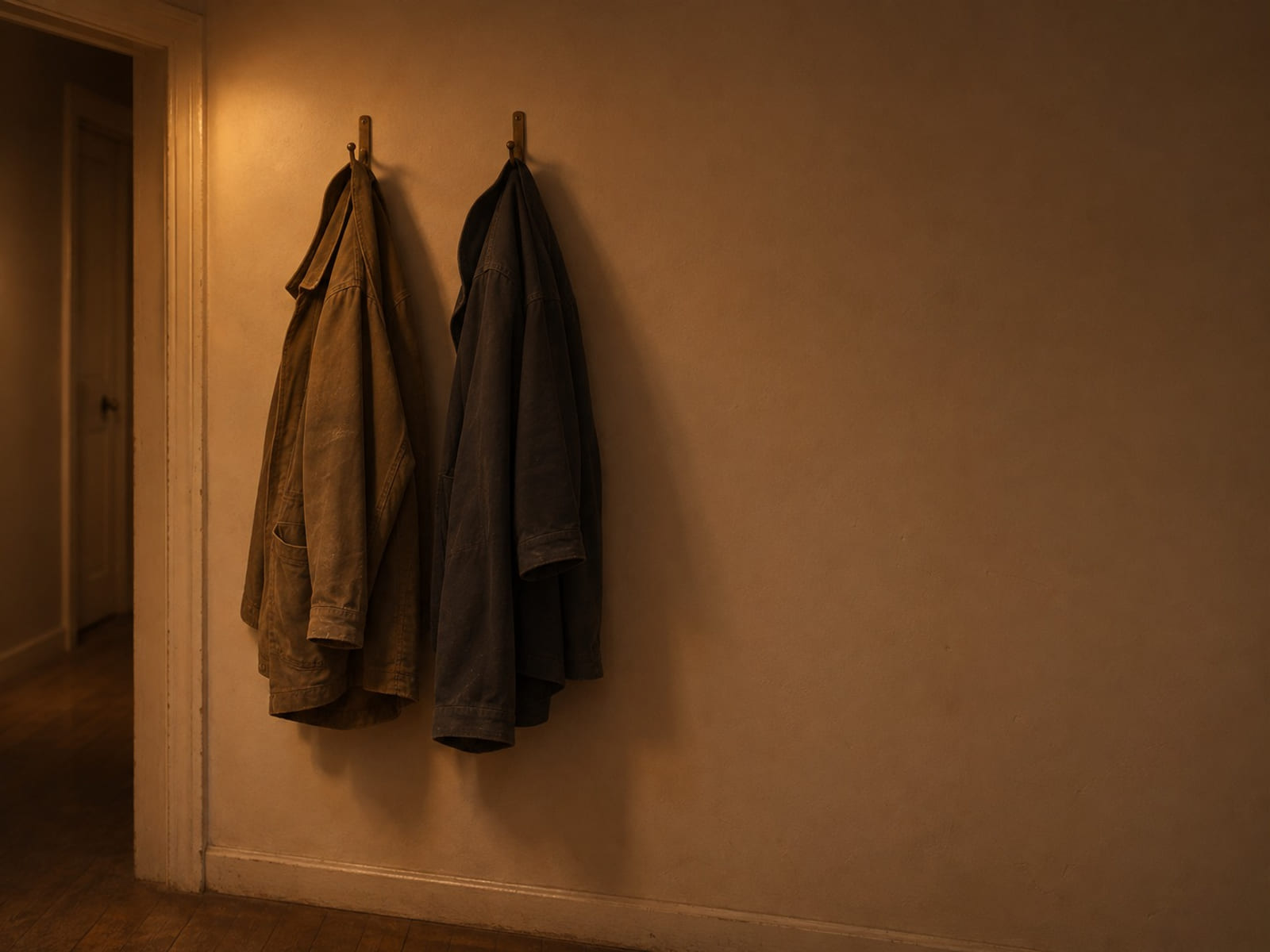
A walk asks nothing of either of you.
People also ask whether there is a psalm for restoring a marriage, and how to save a marriage when a spouse will not try. Psalm 25:16-17 gives you words for asking God to turn toward you, as you are. Ecclesiastes 4:9-12 is the Teacher's observation that two are better than one, because when one falls the other lifts them up, and it closes with the image of a cord of three strands that is not quickly broken. Both are words for the asking, to pray for yourself and for the person you married. What becomes of the marriage stays with the two people in it.
Lines that land hard, and better ones
Some things said to people in this marriage land hard, and you may have said one of them yourself, or had one said to you. Beside each one sits a kinder line of our own.
In place of "You are unequally yoked, so leave," try "You are married, and 1 Corinthians 7 was written to people in exactly your place." In place of "You should have known better," try "You are here now, and so is the person you love." In place of "Your witness will win him" or "Pray and he will convert," try "Keep praying for him because you love him, and leave his faith between him and God."
In place of "God will restore your marriage," try "I'll pray for both of you, by name." And in place of "Just submit" or "Win him without a word," said to somebody who is afraid at home, ask "Are you safe?" and give them the Hotline or the route for their country.
1 Corinthians 7:14 speaks of the unbelieving husband or wife as part of a household made holy: a person at home, a husband or wife.
Questions people ask
What does "unbeliever" mean in 1 Corinthians 7?
It describes a husband or wife who had not accepted the Christian message the believing spouse had come to. Commentators use it as a plain description of the situation in Corinth, and many readers today prefer a gentler phrase such as "a spouse who does not share my faith." Both name the same marriage.
Does a Catholic need permission to marry someone who is not Catholic?
Yes. The Catechism says a mixed marriage needs the permission of church authority, and a marriage with an unbaptized person needs a dispensation for it to be valid in the Church. A parish priest can explain how either is requested.
How common is it to be married to someone of a different religion?
Very common. Pew Research Center, surveying US adults from July 2023 to March 2024, reported that 26 percent of married adults have a spouse with a different religious identity, including 13 percent where one is Christian and the other religiously unaffiliated.
Why do some Spanish Bibles call the unbelieving spouse "infiel"?
In the Reina-Valera 1909, "infiel" in 1 Corintios 7 means unbelieving, the older sense of the word. In everyday Spanish today it usually suggests an unfaithful spouse, so many Spanish speakers use "no creyente" or "cónyuge no creyente" for clarity.
Where to go next
If a night feels heavier than this, reach a person. In the United States, call 988 or text 988, the 988 Suicide and Crisis Lifeline. In Canada, call or text 9-8-8. In the United Kingdom and Ireland, Samaritans is on 116 123. In Australia, Lifeline is on 13 11 14. In Spain, call 024; in Mexico, the Línea de la Vida; in Argentina, the Centro de Asistencia al Suicida. Anywhere else, Find A Helpline lists lines by country.
If you are afraid at home: the National Domestic Violence Hotline in the United States, Refuge in the United Kingdom, and 1800RESPECT in Australia.
This Sunday, tell one person at church that you come alone, or say Psalm 25:16-17 once on the way home.
Bible Nudge offers one passage with the verses around it and a note on why it may fit what you are carrying. Find a passage.
Words that come up here
Tap a term to see what it means.
Unequally yoked. The King James wording of 2 Corinthians 6:14, from the image of two different animals sharing one yoke.