

The night before a baptism is full of small jobs: a card for the family, a towel in a bag, a quiet question about whether you are even allowed to be there. Some people carry a bigger worry, about a baptism as a baby, a second baptism, or someone who died without one. Nobody is condemned for any of it: not the baptized, the unbaptized, the person baptized as a baby or twice, or a parent who has not baptized a child.
If you only have a minute
For tonight
Romans 15:13, a one-sentence prayer about hope.
On the day
A guest is ordinarily welcome. Ask about photos, fees and gifts.
If you are nervous
Water, an audience and a camera can each be raised beforehand.
Romans 15:13, a prayer for the night before
The site's passage for hope is short enough to say on the way there:
Now may the God of hope fill you with all joy and peace in believing, that you may abound in hope, in the power of the Holy Spirit.
Paul writes it as he closes a call to a patient, welcoming community of Jews and Gentiles, and a few lines earlier he says, "Therefore accept one another, even as Christ also accepted you, to the glory of God." The prayer asks for hope to be given rather than produced, which suits anyone who cannot make themselves feel a certain way tonight. A question to carry: Where do you most need hope to be given rather than generated? Here is Romans 15:13 with the verses around it.
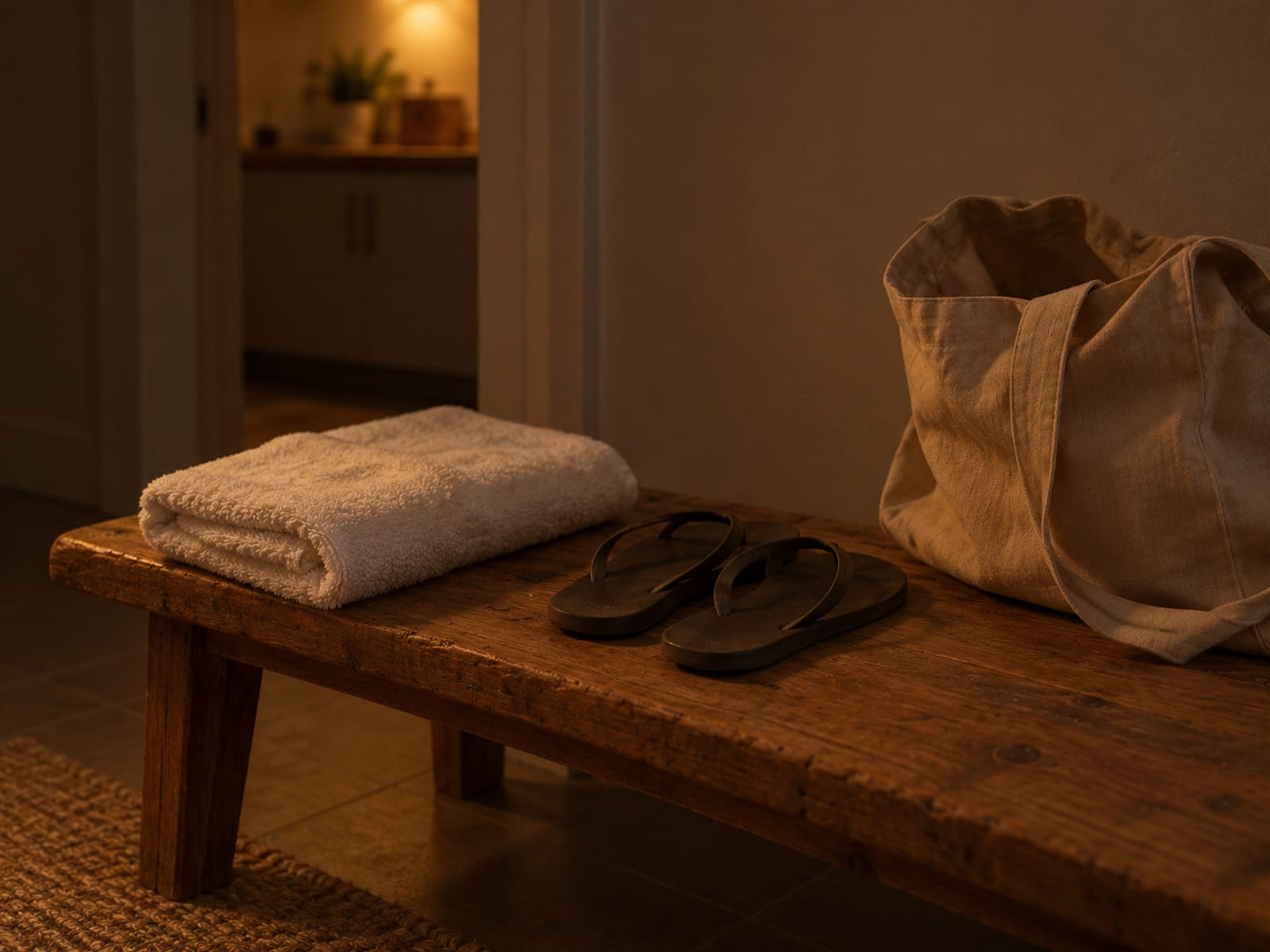
Packed the night before.
Why Christians baptize, in the texts' own words
In Matthew 3:13-17, Jesus comes to John at the Jordan, and John objects. Jesus answers, "Allow it now, for this is the fitting way for us to fulfill all righteousness." The Spirit comes down like a dove, and a voice says, "This is my beloved Son." In Matthew 28:16-20, Jesus sends his followers to make disciples of all nations, "baptizing them in the name of the Father and of the Son and of the Holy Spirit."
Paul turns to water twice. In Romans 6:3-4, "We were buried therefore with him through baptism into death," so that "we also might walk in newness of life." In Galatians 3:26-29, those "baptized into Christ have put on Christ," and are one in him.
The Greek word, baptizo, means to dip or immerse. Jewish ritual immersion came first; Mishnah *Mikvaot* 1.1 discusses suitable waters. Scholars disagree about whether baptism of converts predated the Gospels.
How the main churches describe it
- Catholic: the Catechism calls Baptism "the basis of the whole Christian life, the gateway to life in the Spirit" (1213), and baptizes infants (1250).
- Orthodox: the Orthodox Church in America describes triple immersion followed at once by Chrismation and Communion, for infants too.
- Lutheran: the Small Catechism calls Baptism "the water included in God's command," for infants too.
- Anglican and Episcopal: the Book of Common Prayer allows water poured or the person immersed.
- Reformed and Presbyterian: the Westminster Confession, chapter 28 allows pouring or sprinkling, and infants of believing parents.
- Baptist: the Baptist Faith and Message 2000, Article VII describes a believer immersed.
- Assemblies of God and Life.Church: immersion as a public declaration of faith, per the Assemblies of God and Life.Church.
- Churches of Christ: immersion connected with repentance and forgiveness.
- Adventist, Mennonite, Anabaptist, Witnesses: after personal faith or dedication.
- Latter-day Saints: Article of Faith 4 names baptism by immersion, ordinarily at age eight or later; the church also baptizes for the dead, reading 1 Corinthians 15:29 that way, while others read that verse as a practice Paul mentions without endorsing.
- Quakers and the Salvation Army: no water baptism; the Salvation Army describes a public declaration instead.
The World Council of Churches' *Baptism, Eucharist and Ministry* (1982) calls baptism "the sign of new life through Jesus Christ" and asks churches to recognize one another's baptisms where water, the Trinitarian formula and the intention to follow Christ's command are present, while noting disagreement over infants. See also Baptist vs. Methodist.
If you were baptized as a baby, twice, or not at all
Nobody is condemned for any of these, and each church decides what it recognizes. So, the real answer to "does mine count?" comes from the church you are asking. Catholic teaching says Baptism is not repeated (1272), and that "God has bound salvation to the sacrament of Baptism, but he himself is not bound by his sacraments" (paragraph 1257). Reformed, Lutheran and Orthodox churches do not ordinarily baptize again. Baptist churches may baptize someone baptized as an infant, since they do not count the first as a believer's baptism. Churches of Christ connect immersion with forgiveness, and congregations differ on a prior baptism. Many Reformed, Baptist and evangelical writers call baptism commanded and important, with acceptance resting on grace and faith.
The texts are read in different directions too. In Luke 23:43, Jesus tells the criminal beside him, "today you will be with me in Paradise"; some traditions hear God not bound by the sacraments, others say baptism was not possible then. Mark 16:16 says, "He who believes and is baptized will be saved," but Mark 16:9-20 is absent from the oldest Greek manuscripts. John 3:5, "born of water and spirit," is read as baptism by sacramental traditions and as cleansing or natural birth by others. The disagreement stands. For a parent grieving a child: Bible verses for the loss of a child.
What happens on the day, and what a guest does
At a Catholic infant baptism, the Archdiocese of Chicago lists the church door, naming the child, questions to parents and godparents, readings, water, chrism, a white garment and a candle. An adult usually comes in at the Easter Vigil. An Orthodox baptism, per the Greek Orthodox Archdiocese, has renunciations, triple immersion, chrismation and Communion. A believer's baptism at Life.Church or the Assemblies of God has a testimony, a few words from the pastor, and "I baptize you in the name of the Father, and of the Son, and of the Holy Spirit," as the person is lowered back and raised.
Photography, fees, clothing and gifts vary by church and family, so ask. Visitors are ordinarily welcome. For a guest, "I am so glad to be there with you" is enough, with a card that has a line you mean. Going to church for the first time covers a service, Communion included.

The card, not yet sealed.
If you are afraid of the water, the crowd or the camera
All three are ordinary. The Didache, chapter 7, says that if immersion is not possible, water may be poured three times on the head. Catholic and Anglican rites pour, and the Westminster Confession permits pouring or sprinkling. The Orthodox Church in America's clergy guidelines prefer triple immersion and leave exceptions to the priest or bishop. Many churches can arrange a smaller gathering, a private baptism, or help in and out of the water; ask, and ask whether it will be filmed and whether you must speak. If fear of water is overwhelming, the NHS page on phobias describes treatment routes.
If a teenager is being asked to decide, or anyone feels pressured: the churches that baptize believers describe it as following a person's own repentance and faith, so questions to a pastor first are within reason. To a partner who is not religious: "This matters to me, and I would love you to be there. You do not have to believe it."
Lines that land badly, and better ones
People report being told their baptism "does not count," that an unbaptized relative is lost, that fear means weak faith, or that feeling nothing means they were not sincere. Better lines:
- "Your church and mine may see this differently, and I am glad you asked."
- "I am so sorry. I do not know what happens to those we love, and I am here."
- "Some people feel a great deal and some very little; neither says anything about you."
- "Take the time you need."
If a church shamed you, try church hurt.
If it all feels like too much
If worry has turned into thoughts of ending your life, please reach a person tonight. In the United States, call or text 988 for the 988 Suicide and Crisis Lifeline. In Canada, call or text 9-8-8. In the United Kingdom and Ireland, Samaritans is on 116 123. In Australia, Lifeline is 13 11 14. Anywhere else, Find A Helpline lists lines by country. For grief, Cruse Bereavement Support serves the United Kingdom, Pieta is on 1800 247 247 in Ireland, and Griefline is on 1300 845 745 in Australia.
One step for tonight: say Romans 15:13 once aloud, and ask the church or the family one question you have been carrying.
Bible Nudge gives a person one passage with the story around it, and Find a passage is where to start.
Words that come up here
Tap a term to see what it means.
Chrismation. Anointing with blessed oil after baptism in Orthodox churches.