

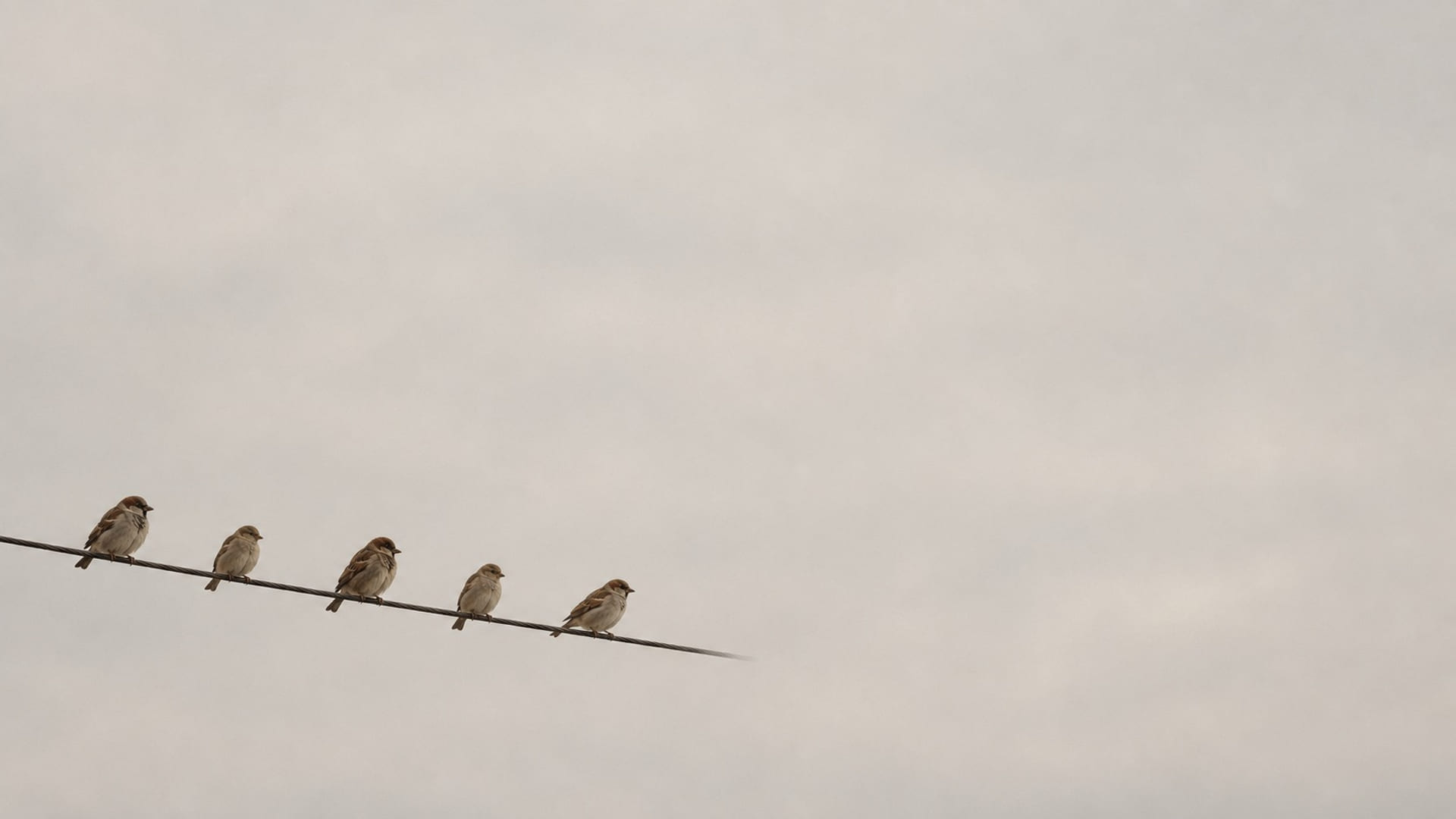
Underneath the question about a sign there is often another one: will it be all right? Many people notice a number, a feather, a bird or a song during a hard wait and wonder whether it means something.
Scripture, the Bible's own writings, records people asking for signs and being given them, and traditions differ on whether God gives signs today. Nobody can read from a feather how a scan, a surgery or a court date will come out, and there are still words for the fear while you wait.
If you only have a minute
Words for the wait
Psalm 56:3-4, which begins "When I am afraid."
Tonight
Read it aloud once, then say plainly what you are afraid of.
A practical step
Ask the clinic when and how you will hear.
Psalm 56:3-4, for the waiting itself
When I am afraid, I will put my trust in you. In God, I praise his word. In God, I put my trust. I will not be afraid. What can flesh do to me?
In the King James it begins, "What time I am afraid, I will trust in thee." It is David's prayer while in danger from enemies, and its heading ties it to the Philistines seizing him in Gath; Matthew Henry, a Reformed commentator, reads that setting as danger producing fear and prayer. The verses before say enemies "want to swallow me up," and the verses after say "they twist my words." The psalm moves between fear and trust rather than treating the fear as something to get past first.
The first words admit the fear, so someone still afraid can say them. The Hebrew words are yare, "to fear," and batah, "to trust" or "rely on" (Bible Hub lexicon). Verse 8 adds, "You count my wanderings. You put my tears into your bottle. Aren’t they in your book?" It offers a line to say while you wait, and a God who keeps count of the tossing nights.
Read Psalm 56:3-4 aloud once tonight, and hold its question: what are you afraid of right now, if you say it plainly? Other pages read it through the Gath story and for what has not happened yet.

Help for the wait
Macmillan Cancer Support calls waiting for tests and results "a worrying time," says people may feel they have no control, and says results can take from a few days to a few weeks depending on the test. Cancer Research UK calls it "scanxiety," and the American Cancer Society describes the same worry.
Ask the clinic when and how you will be told, and who you can call meanwhile, because not knowing the day is part of the weight. Ask, too, whether a chaplain can sit with you: the Association of Professional Chaplains describes chaplains listening to fear, hope and meaning without deciding a medical outcome. In the UK, NHS 111 is the service for urgent health worries. There are pages for before surgery, cancer patients and health anxiety.
What people report
In a 2023 Pew Research Center survey of 5,079 U.S. adults, 45 percent reported a sudden feeling of connection with something beyond this world, and 30 percent said they had personally encountered a spirit or unseen spiritual force. Fifty-three percent said a dead family member had visited them in a dream or another form, and 34 percent felt a dead relative's presence in the past year. The survey asked about spiritual experiences in general, so it gives a sense of how ordinary these moments are without counting feathers or numbers.
In the 2008 Baylor Religion Survey, reported by Kay and colleagues, 55 percent of 1,721 U.S. adults agreed "I felt God's presence," 41 percent agreed "I felt guided by God in the midst of daily activities," and 20 percent agreed "I heard the voice of God speaking to me." Alongside those felt experiences, people describe repeated numbers, feathers, rainbows, songs, dreams, a stranger's words, or an answer that arrives right after a prayer.
A believer may take a repeated number or a bird as providence. A skeptic may take it as chance or attention, and Whitson and Galinsky found people who felt less in control saw more patterns in random noise; the NHS describes how hard not knowing can be. These studies report experiences, not where any one comes from.
What Scripture records about asking
Gideon says, "show me a sign that it is you who talk with me" (Judges 6:17); fire consumes his offering, he asks twice with a fleece, and later overhears an enemy's dream. Hezekiah, told he will die, prays and asks, "What will be the sign that Yahweh will heal me?" (2 Kings 20:8), and the shadow goes back ten steps. Ahaz says, "I will not ask, neither will I tempt Yahweh" (Isaiah 7:12), and is given a sign anyway; Jewish and Christian readers take Isaiah 7:14 differently.
Abraham's servant, sent to find a wife for Isaac, stands at a spring and prays for a sign in detail: the young woman who answers, "Drink, and I will also give your camels a drink," is to be the one he is looking for (Genesis 24:12-14). "Before he had finished speaking," Rebekah comes out with her pitcher and does just that (Genesis 24:15-20). Zechariah asks, "How can I be sure of this?" and is given silence (Luke 1:18-20). Thomas says he will not believe until he sees the marks of the nails, and Jesus shows him (John 20:24-29). John then says his signs "are written, that you may believe" (John 20:31).
In Matthew 12:39, Jesus says, "An evil and adulterous generation seeks after a sign," with parallels in Matthew 16, Mark 8 and Luke 11; the people asking are scribes and Pharisees testing him after healings, not someone frightened or grieving. Deuteronomy 13:1-3 adds that a sign coming true does not by itself settle what to follow. The passages pull in different directions. Matthew Henry and John Gill, both Reformed, read the fleece as a concession to Gideon's weakness, not a pattern, while Rashi notes how unusual the sign was. The fleece also appears in what the Bible says about doubt.
For the sky, Genesis 9:13 calls the rainbow "a sign of a covenant between me and the earth," and Psalm 19:1 says, "The heavens declare the glory of God."
How traditions speak about signs now
The Catechism of the Catholic Church says "God can reveal the future to his prophets or to other saints" (2115) and "All forms of divination are to be rejected" (2116). When the Vatican's Dicastery for the Doctrine of the Faith set out new Norms in May 2024 for judging reported apparitions and other unusual events, it described the Church discerning "whether signs of a divine action can be ascertained." Even its Nihil obstat, a Latin phrase meaning "nothing stands in the way," is given "without expressing any certainty about the supernatural authenticity of the phenomenon itself," and Catholics are not required to believe a private revelation.
The Westminster Confession, Reformed, treats Scripture as the settled standard, to which "nothing at any time is to be added." The Talmud, in Hullin 95b, discusses Eliezer's sign about Rebecca, the servant's prayer at the well, and questions relying on omens, and Deuteronomy 18 forbids divination.
If you are hoping for a sign from someone who died
Cruse Bereavement Support says that after a death people may see, hear, feel, smell or sense the person, and that this is common and can comfort or disturb. One person told Cruse, "If I feel I need advice, comfort, or reassurance I nearly always see a white feather close by and that is when I feel my husband's presence and that he is looking out for me." Cruse also says this is not by itself a sign of mental illness. People hold it as a gift, as grief and memory, or as comfort without a claim about its source.
If you asked and saw nothing, an empty sky is not a verdict on your love or your faith, and Psalm 56 waits on no sign. For the longer road, read what the Bible says about grief or who in the Bible grieved.

What lands badly, and what helps
Some replies sting: "you are testing God," "God does not give signs," "that is the devil," "it is just a coincidence," "you need more faith." Each one settles the question for the other person and leaves them alone with the wait. These land better: "That sounds like a heavy wait. What are you most afraid of?" "I will sit with you while you wait for the call." "Tell me about the feather. What did it mean to you?" "I do not know what it means, and I am here."
If someone you love sees signs everywhere, ask and listen, and never call them deluded or ill. A sign is not a reason to stop treatment, leave a partner, spend money or set aside a doctor's or lawyer's advice; talk those choices through with a doctor, a lawyer or someone you trust. If someone hears voices others cannot, and it distresses them, the NHS (UK) and Mind (UK) point to a doctor or mental-health service, and how to know if God is speaking to you covers more.
Questions people ask
Is it a sin to ask God for a sign? Gideon, Hezekiah and Zechariah asked, and Matthew 12 records Jesus refusing hostile questioners. None of these passages condemns a frightened person for asking.
How do you know which signs are from God? Traditions answer this differently, and many suggest testing an impression slowly rather than acting on it alone. Paul writes, "Test all things, and hold firmly that which is good" (1 Thessalonians 5:21), and Deuteronomy 13:1-3 warns that even a sign that "comes to pass" can point the wrong way. Praying it over, reading Scripture and talking it through with someone you trust are the usual places to start.
When does God send signs? In Scripture they come at very different moments: to Gideon before a battle, to Hezekiah in illness, to Abraham's servant at a well, to Zechariah at news of a birth. Traditions differ on whether God gives signs now, and nobody can name a day or a season for one. Psalm 56:3-4 can be prayed in the meantime, whether or not anything comes.
Is a rainbow a sign from God? In Genesis 9:12-16 the rainbow is "the token of the covenant" with "every living creature," a promise that "the waters will no more become a flood to destroy all flesh." It is a sign given to everyone at once, so you can take it as that promise when you see one, alongside whatever else you are waiting on.
What are the seven signs of Jesus? Commentators usually count seven in John's Gospel: water into wine (John 2:1-11), healing the royal official's son (4:46-54), healing the man at Bethesda (5:1-15), feeding the five thousand (6:1-14), walking on the sea (6:16-21), healing the man born blind (9:1-7) and raising Lazarus (11:1-44). John calls Cana "This beginning of his signs" (2:11) and the healing of the official's son "the second sign" (4:54). He adds that Jesus did "many other signs in the presence of his disciples, which are not written in this book" (20:30).
For your own nights
If fear has become thoughts of ending your life, reach a person tonight. In the United States, call or text 988, with a Spanish option. In Canada, call or text 9-8-8. In the UK and Ireland, Samaritans is on 116 123. In Australia, Lifeline is 13 11 14. In Spain, call the 024 line; in Mexico, Línea de la Vida on 800 911 2000; in Argentina, the Centro de Asistencia al Suicida on 135 in Buenos Aires and nearby areas, or (011) 5275-1135. Anywhere else, including Colombia, Find A Helpline lists lines by country, or call your local health authority or emergency number. For grief, there is Cruse in the UK and Griefline in Australia.
Where to go next
Tonight, read Psalm 56:3-4 once aloud, say the fear plainly, and ask the clinic, or the person you are waiting on, when you will hear. If you carry something else, Bible Nudge can take a line about it and offer one passage with the verses around it. Find a passage.
Words that come up here
Tap a term to see what it means.
Providence. The belief that God cares for and guides the world, including ordinary events.