


Someone on Reddit's r/Christianity asked, "Is it bad to doubt or have questions?" On Reddit's r/Catholicism, another wrote, "Had doubts seconds before receiving Eucharist, am I in mortal sin?" A post on Reddit's r/OrthodoxChristianity asked, "How to deal with not having any assurance of salvation?"
The Bible is full of people who doubted, questioned or laughed at a promise, from Sarah to Peter to John the Baptist, and it records what happened to each. The churches differ on when doubt becomes a sin and whether a believer can be sure of salvation. The passage Bible Nudge offers for doubt is James 1:5. Scripture here is from the World English Bible unless the King James Version (KJV) is named.
If you only have a minute
The passage for doubt
James 1:5: ask God, who gives "without reproach."
Peter on the water
The hand comes first, the question second.
John in prison
He sent a question, and Jesus sent back what he was doing.
James 1:5, an invitation to ask
James wrote to people facing trials, inviting them to seek wisdom with honesty:
2 Count it all joy, my brothers, when you fall into various temptations, 3 knowing that the testing of your faith produces endurance. 4 Let endurance have its perfect work, that you may be perfect and complete, lacking in nothing. 5 But if any of you lacks wisdom, let him ask of God, who gives to all liberally and without reproach; and it will be given to him.
The person with questions is told to ask, and God gives "without reproach," which the KJV renders "upbraideth not," an old word for scolding. Bible verses for trials reads the lines before it, and Bible verses for doubting God the harder verses after it.
Tonight, read verse 5 once, slowly, and answer one question in a single line: what is the clearest question you can bring to God right now?

One question, in one line.
Peter on the water
Peter stepped out of the boat and walked toward Jesus. Then: "But when he saw that the wind was strong, he was afraid, and beginning to sink, he cried out, saying, ‘Lord, save me!’ Immediately Jesus stretched out his hand, took hold of him, and said to him, ‘You of little faith, why did you doubt?’" (Matthew 14:30-31).
The hand comes first and the question second, and Peter's cry is three words long. Matthew Henry reads it as weak faith met by ready rescue: "when we call to him, he will stretch out his arm, and save us." Cornelius a Lapide, Catholic, reads "little faith" as faith weakened by fear in his commentary on Matthew 14. It gives you Peter's prayer, short enough for any hour. If doubt and fear arrive together, is it a sin to be afraid? reads the storm scenes.
John the Baptist's question from prison
From prison, John sent disciples to ask, "Are you he who comes, or should we look for another?" (Matthew 11:3; Luke 7:19-20). Jesus pointed them to what was happening: "the blind receive their sight, the lame walk," and "the poor have good news preached to them. Blessed is he who finds no occasion for stumbling in me." Then he told the crowd that "among those who are born of women there has not arisen anyone greater than John the Baptizer."
John Chrysostom, the Greek church father, reads the question as asked for the sake of John's disciples, and John Calvin, Reformed, reads it the same way. If you are doubting after years of faith, the man who baptized Jesus asked this, and his answer was an account of what Jesus was doing, then praise of John. The site's passage for anxiety, "Come to me, all you who labor," comes later in the same chapter.
Laughing at a promise, and asking how
Abraham "fell on his face, and laughed" (Genesis 17:17). Sarah "laughed within herself" (18:12), and Rashi, the medieval Jewish commentator, says "She reflected on her physical condition." At Isaac's birth she said, "God has made me laugh. Everyone who hears will laugh with me" (21:6).
In Luke 1, Zechariah asks, "How can I be sure of this?" and is "not able to speak, until the day that these things will happen." Mary asks, "How can this be, seeing I am a virgin?" The Catholic Haydock commentary says Mary "only asks about the manner," unlike Zechariah seeking a sign. That is a commentator's distinction; Luke leaves the difference to the reader. Bible verses for infertility reads Elizabeth, from the same chapter.
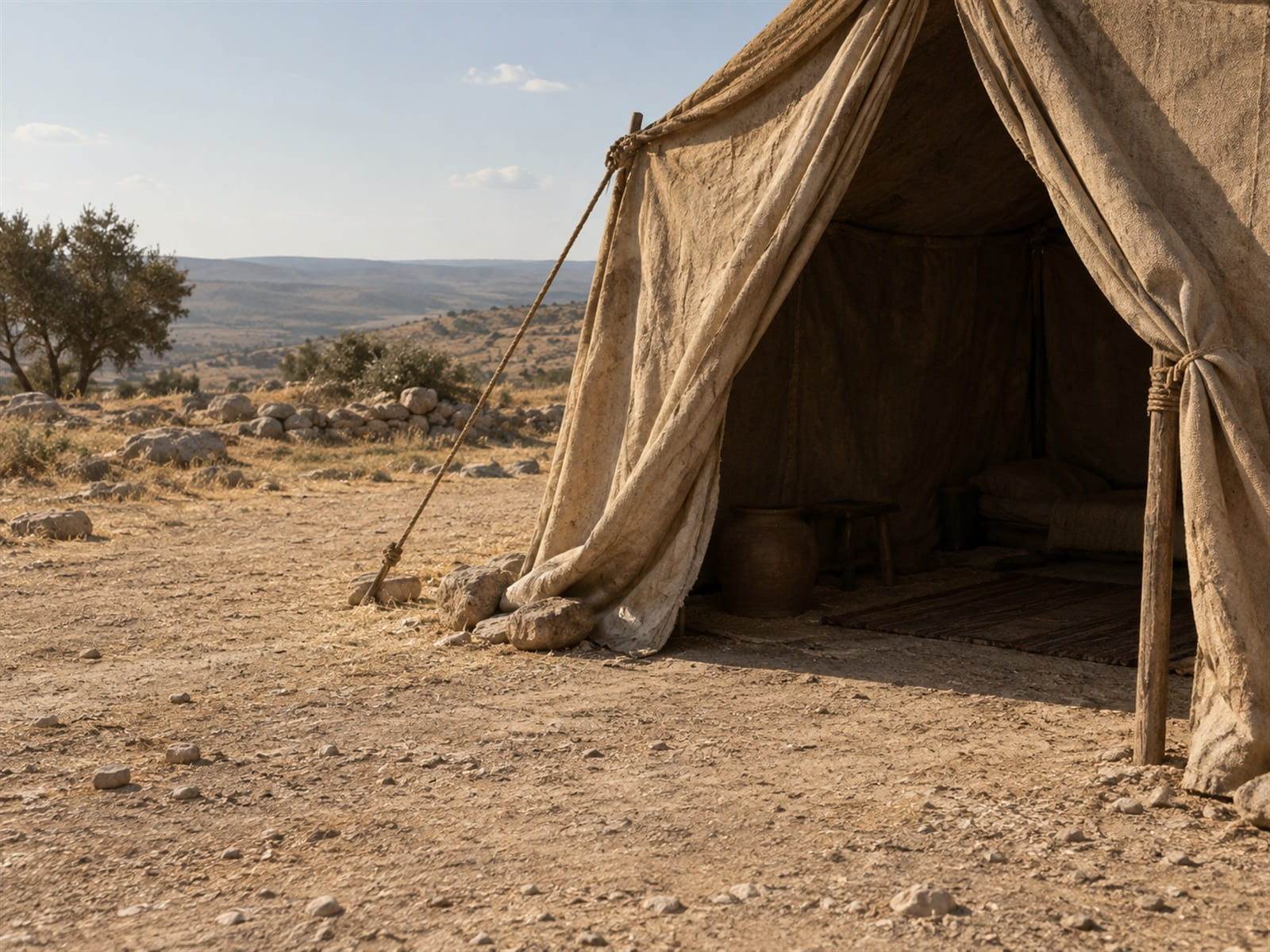
Where Peter stepped out.
The words English Bibles translate "doubt"
Several Greek words sit behind "doubt" and "unbelief" (definitions from Bible Hub's Strong's entries), which helps if one verse has been held over you.
- Distazō, "waver" (1365): Jesus to Peter (Matthew 14:31), and Matthew on the disciples at the mountain, "some doubted" (28:17).
- Oligopistos, "of little faith" (3640): Jesus to anxious listeners (Matthew 6:30; Luke 12:28) and frightened disciples (Matthew 8:26, 16:8).
- Apistia, "unbelief" (570): Jesus "marveled because of their unbelief" (Mark 6:6); Paul says Abraham "didn’t waver through unbelief" (Romans 4:20).
- Meteōrizomai, "be in suspense" (3349): Jesus to his disciples, KJV "neither be ye of doubtful mind" (Luke 12:29).
- Diakrinō, "to separate, discriminate, decide, dispute" (1252): "doubt" in some verses, "dispute" in others, including James 1:6, read in the doubting God post.
Romans 14:23, read with its chapter
This verse is sometimes quoted to a doubter: "But he who doubts is condemned if he eats, because it isn’t of faith; and whatever is not of faith is sin." Paul was writing to a church divided over what may be eaten, and Matthew Henry applies it as "Take heed of acting against a doubting conscience."
Is doubt a sin? What the churches teach
The Catholic Catechism separates two kinds: "Voluntary doubt about the faith disregards or refuses to hold as true what God has revealed and the Church proposes for belief. Involuntary doubt refers to hesitation in believing, difficulty in overcoming objections connected with the faith, or also anxiety aroused by its obscurity" (2088). John Henry Newman wrote in 1864, "Ten thousand difficulties do not make one doubt." The Westminster Confession, Reformed, describes saving faith as accepting, receiving and resting upon Christ (14.2). The Orthodox Church in America describes sin as "missing the mark." Rabbi Jonathan Sacks, on Abraham's "Shouldn’t the Judge of all the earth do right?" (Genesis 18:25), treats questioning God as part of the covenant conversation.
If you lie awake doubting your salvation
The Council of Trent (1547), Catholic: "no one can know with a certainty of faith, which cannot be subject to error, that he has obtained the grace of God." The Westminster Confession (1647) calls it "an infallible assurance of faith" that may be "shaken, diminished, and intermitted" (18.2, 18.4). John Wesley, Methodist, in his 1746 sermon The Witness of the Spirit, calls it "an inward impression on the soul" by which the Spirit witnesses "that I am a child of God." The Orthodox Church in America describes salvation as an "ongoing process of spiritual growth."
John wrote to those who believe in the name of the Son of God, in the KJV, "that ye may know that ye have eternal life" (1 John 5:13). If checking has become nightly, with relief lasting a moment, the doubting God post has a section on that, with help by country.
Doubting yourself
Moses asked, "Who am I, that I should go to Pharaoh?" (Exodus 3:11). Jeremiah said, "Ah, Lord Yahweh! Behold, I don’t know how to speak; for I am a child," and was answered, "Don’t be afraid because of them, for I am with you to rescue you" (Jeremiah 1:6-8). Gideon asked for a sign with a fleece, twice (Judges 6:36-40); Bible verses for courage reads his fear. Each said it aloud to God.
Pauline Clance and Suzanne Imes, from clinical work with more than 150 high-achieving women, named the "impostor phenomenon" in 1978 "to designate an internal experience of intellectual phoniness". It describes something different from doubting God.
Quotations about doubt, and where they come from
Paul Tillich, Dynamics of Faith (1957): "But doubt is not the opposite of faith; it is an element of faith." Frederick Buechner, who in a 2002 Christian Century interview traced the line to Wishful Thinking (1973): "Doubts are the ants in the pants of faith." Tim Keller's "you must doubt your doubts" is attributed to The Reason for God (2008), page varying by edition.
When your teenager starts asking
A parent on Reddit's r/Catholicism titled a post "My Teens Are Rejecting Religion." Barna's 2022 US research reports that "Over half of teens and adults" had doubts at least sometimes. The Fuller Youth Institute, in 2013, found "doubt can help form our faith in stronger and perhaps more lasting ways," and described questions "pushed underground" in some settings. Two suggestions of this site's own: ask what the question is before answering it, and read Thomas's scene in John 20 together, as Bible verses for doubting God does.
Some questions come up over the kitchen counter.
When doubt comes with low mood
Kathleen Galek and colleagues, in the Journal of Adult Development in 2007, studied how religious doubt relates to distress and wellbeing among 1,676 US adults, a study of association. The NHS says, "If you have a low mood that lasts 2 weeks or more, it could be a sign of depression," and to see a GP, a family doctor, if it lasts or is hard to cope with.
If doubt has turned into thoughts of ending your life, please reach a person tonight. In the United States, call or text 988. In Canada, call or text 9-8-8. In the United Kingdom and Ireland, Samaritans is on 116 123. In Australia, Lifeline is 13 11 14. Anywhere else, Find A Helpline lists services by country.
Where to go next
Read James 1:5 with the verses around it, write your question in one line, and bring it to God. Bible Nudge can also take a line in your words and return a passage. Find a passage.
Words that come up here
Tap a term to see what it means.
Reformed. The Protestant tradition descending from John Calvin and others.