


One mother posted on Reddit's r/Mommit that she was "Feeling discouraged, overwhelmed, guilty... you know, all the mom things." Another in the same thread, with teenagers and a baby, had "no time or brain capacity for deep study and time to be in the Word." On r/TrueChristian, a mother wrote that she felt "Like I was failing God and failing as a mom." What follows fits into the minute you have: one passage first, and further down, a section for the weeks after a birth.
If you had a baby recently and something feels wrong, a doctor, midwife or health visitor is the person to tell, and the section on the weeks after a birth has the lines for your country.
If you only have a minute
Read first
Exodus 18:17-18, where someone else names the load as too heavy.
One question
What are you carrying alone that was never meant to be one person’s job?
For those carrying young
Isaiah 40:11, "He will gently lead those who have their young."
For a friend
Send the verse with an offer of a meal, a school run or an hour.
Exodus 18:17-18: too heavy for one person
Moses’ father-in-law said to him, “The thing that you do is not good. You will surely wear away, both you, and this people that is with you; for the thing is too heavy for you. You are not able to perform it yourself alone.
Moses is settling every dispute himself, "from morning to evening", and his father-in-law, Jethro, watches a full day of it. The judgment lands on the arrangement rather than on Moses, so the passage names how heavy the load is and lets somebody else say it first. Bible verses for work burnout reads it closely.
Read verse 18 once and answer this in a line: "What are you carrying alone that was never meant to be one person’s job?" If there is room after that, name one small thing somebody else could hold this week. The chapter goes on to describe that for Moses: "and they shall share the load with you" (Exodus 18:22).
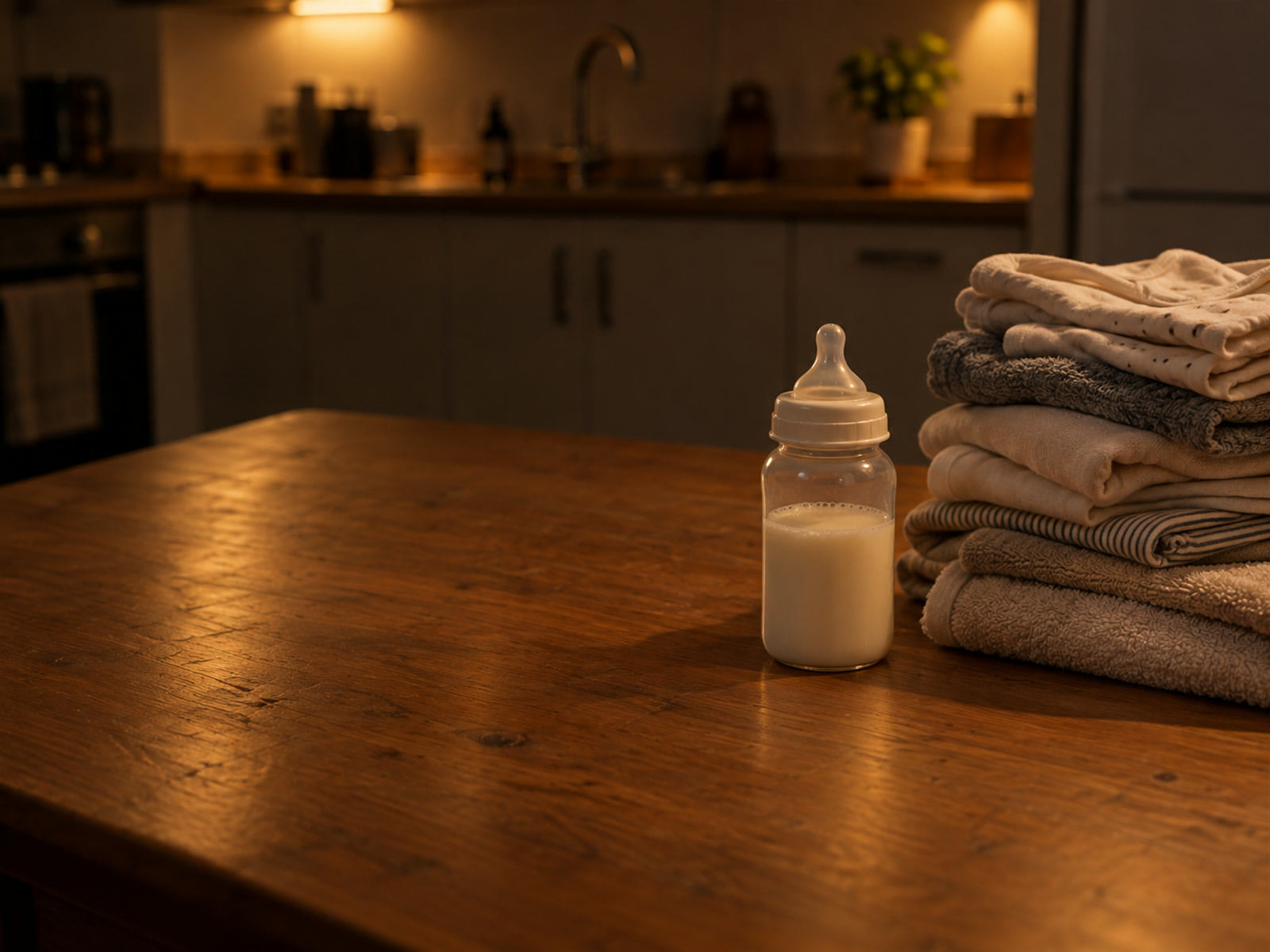
The lists nobody sees
Much of the load is in your head. Sociologist Allison Daminger's 2019 study of 35 couples in the Boston area gives it a name, cognitive household labor: "anticipating needs, identifying options for filling them, making decisions, and monitoring progress." In her sample, the women more often did the anticipating and the monitoring.
Roskam and Mikolajczak's Parental Burnout Assessment describes parental burnout in four parts: exhaustion in the parenting role, a sense of contrast with the parent you used to be, feeling fed up with parenting, and emotional distance from your children. Read it as a description to bring to a doctor if it sounds familiar. What the Bible says about burnout reports their 42-country study.
Isaiah 40:11, for those who have their young
Isaiah 40 announces good news to Jerusalem, and then comes the shepherd:
He will feed his flock like a shepherd. He will gather the lambs in his arm, and carry them in his bosom. He will gently lead those who have their young.
The Hebrew word (the original language here) behind "those who have their young" is usually glossed as ewes with lambs, or nursing ewes. The Jewish commentator Rashi sees a shepherd leading nursing sheep gently, and John Calvin writes that the Lord "will not treat his flock with severity." The verse places the ones carrying young among those handled gently, and it gives you words for being led at their pace. Bible verses for dementia caregivers reads it for carers.
A mother's care in Scripture
Scripture, the Bible's own words, also uses a mother's care to speak about God and about gentleness. In Isaiah 49, Zion, the city standing for God's people, says, "Yahweh has forsaken me, and the Lord has forgotten me." The answer is a mother: "Can a woman forget her nursing child, that she should not have compassion on the son of her womb? Yes, these may forget, yet I will not forget you!" Psalm 131, headed as a song of David, says, "Surely I have stilled and quieted my soul, like a weaned child with his mother"; what the Bible says about rest gives that psalm for a mind that will not slow down. Paul tells the church at Thessalonica, "we were gentle among you, like a nursing mother cherishes her own children" (1 Thessalonians 2:7). The Catholic theologian Elizabeth Johnson calls such imagery "a genuine metaphor" for God.
When prayer has shrunk to a minute
Further down that r/Mommit thread on Reddit, one mother wrote, "I've been feeling guilty about that." Another wrote, "I have the Bible app’s daily bible verse set as a ‘widget’ on my phone." One verse on a lock screen, read at a red light or during a feed, is reading. The passages on this page were chosen to be short enough for exactly that.

If what sits heavy is anger or resentment, the Catholic Catechism teaches that the passions, our strong feelings, "are not morally good or evil in themselves" (1767). That is one tradition's teaching.
Wanting to get away
A mother caring for her daughter asked on Reddit's r/Christianity, "what if I could escape and getaway and be free for a few days with no responsibilities." And then, "would that be the right choice, or would that be selfish given all the responsibilities I have." In Mark 6:31 Jesus tells his tired disciples, "You come apart into a deserted place, and rest awhile," because "they had no leisure so much as to eat." What the Bible says about burnout reads that scene. Martha in Luke 10 comes up here too, and Bible verses for stress reads her as a busy host rather than a model for mothers.
Where Proverbs 31 comes from
Proverbs 31 is often held up to mothers. Verse 1 calls it "the revelation which his mother taught him", words King Lemuel's mother gave her son. Verses 10 to 31 are an acrostic poem, each verse beginning with the next letter of the Hebrew alphabet. The Catholic NABRE note reads it "more symbolically (and more likely), a portrait of a household ruled by Woman Wisdom." Raymond Apple lists three Jewish readings, among them Jewish womanhood in general and a model wife. It is a poem honoring somebody, and you can let it stand as that. Bible verses for the death of a mother gives it for a funeral.
If you are the friend
Two things people send can land badly. "God won't give you more than you can handle" is usually traced to 1 Corinthians 10:13, which in its setting is about temptation and the way through it. And one person wrote on Reddit's r/exchristian, "When I tell you that I’m struggling and really overwhelmed, please don’t send me Bible verses and think you ate with that. It only makes me feel worse." The same post says, "I only got verses or prayers instead of actual help."
So, send the verse with an offer of something real: a meal, a school run, an hour. The site's Burnout topic set Isaiah 40:31 and Galatians 6:9 aside for a worn-out reader, and Bible verses for work burnout explains why.

The weeks after a birth
The NHS says the baby blues "usually goes away within 2 weeks of the birth," and calls postnatal depression "a common mental health condition that can happen after having a baby." The signs it lists include "a persistent feeling of sadness and low mood", "difficulty bonding with your baby" and "frightening thoughts". The WHO says about "13% of women who have just given birth experience a mental disorder, primarily depression."
Some mothers have unwanted, intrusive thoughts. Maternal OCD, a UK charity, describes them and says, "There is no reported case of a mum acting on her obsessional intrusive thoughts." The step is to tell a doctor, midwife or health visitor, so they can tell one thing from another.
Postpartum psychosis is different. The NHS says it "should always be treated as a medical emergency," so the step is 999 in the UK or 911 in the United States, now.
For mothers in the United States, the National Maternal Mental Health Hotline is 1-833-TLC-MAMA (1-833-852-6262) and the PSI HelpLine is 1-800-944-4773. In the UK, PANDAS is on 0808 1961 776. In Australia, PANDA is on 1300 726 306. Everything above is a description to take to a professional, and telling one is the whole task.
Questions people ask
How do I tell the baby blues from postnatal depression? The NHS says the baby blues are common in the first week after birth and usually pass within two weeks. Anything that lasts longer is worth telling your doctor, midwife or health visitor.
Is Proverbs 31 about one real woman? Readers differ. TheTorah.com records a reading of it as Wisdom in person, and Enduring Word reads it as a virtuous wife.
Is anger at my children a failure of faith? The Orthodox priest Stephen Freeman writes that feelings themselves are not sins, though they can become occasions for passion.
Where to go next
If you are thinking about ending your life, please reach a person now. In the United States, call or text 988 for the 988 Suicide and Crisis Lifeline. In Canada, call or text 9-8-8. In the United Kingdom and Ireland, Samaritans is on 116 123. In Australia, Lifeline is 13 11 14. Anywhere else, Find A Helpline lists lines by country. After a birth, the maternal lines above are there too.
For today, read Exodus 18:17-18 with the verses around it, and read verse 18 once.
Bible Nudge can also take a line in your own words and come back with one passage and what surrounds it. Find a passage.
Words that come up here
Tap a term to see what it means.
Cognitive household labor. The thinking work of running a home: noticing needs, finding options, deciding, and keeping track.