


You can pray in your own words, plainly. Ask for the person to be at peace, for their pain to be eased, and for them to know they are loved, and ask something for yourself as well. You can read a psalm aloud, hold their hand, and ask today for a chaplain, priest or pastor to come.
Nobody needs the right words to start. A short prayer said quietly, or a few lines of a psalm read slowly, is enough to begin with.
If you only have a minute
Pray in your own words
"God, give her peace. Ease her pain. Hold her, and hold us."
Ask for a chaplain tonight
Ask the nurse to contact the hospital chaplain, who serves people of any faith or none.
Read aloud
Psalm 23, whole, saying the person's name. Psalm 31:5 if you want a prayer of entrusting.
Say the four things
"Please forgive me." "I forgive you." "Thank you." "I love you."
For you
Eat, sleep and step out when you can. The nurse is the one to ask about the hour.
Who do you call for a chaplain, priest or pastor?
Ask today, and ask early. Hospital and hospice teams are used to this request, and nobody has to wait until the last hours to make it. Here is who to reach:
- In a hospital, ask a nurse to contact the hospital chaplain. A chaplain serves people of any faith or none, and can reach an on-call priest, rabbi, imam or pastor.
- For the Catholic Anointing of the Sick, Viaticum or the Commendation of the Dying, call the hospital chaplain or the parish's emergency number.
- For an Orthodox priest, call the parish priest or the diocesan office.
- At home with hospice, ask the hospice's spiritual-care team. At night, use the hospice's own 24-hour number.
- If no one answers where you are, call the nurse or the hospice line and ask who is on call for spiritual care.
On the phone, it helps to say four things: the person's faith, the rite or prayer the family wants, whether the person is conscious, and how urgent it is.
The Catholic Catechism describes the Anointing of the Sick as a sacrament for serious illness and the frailty of old age, not only for the last hours. It can be received again if the illness worsens, so a family can ask early.
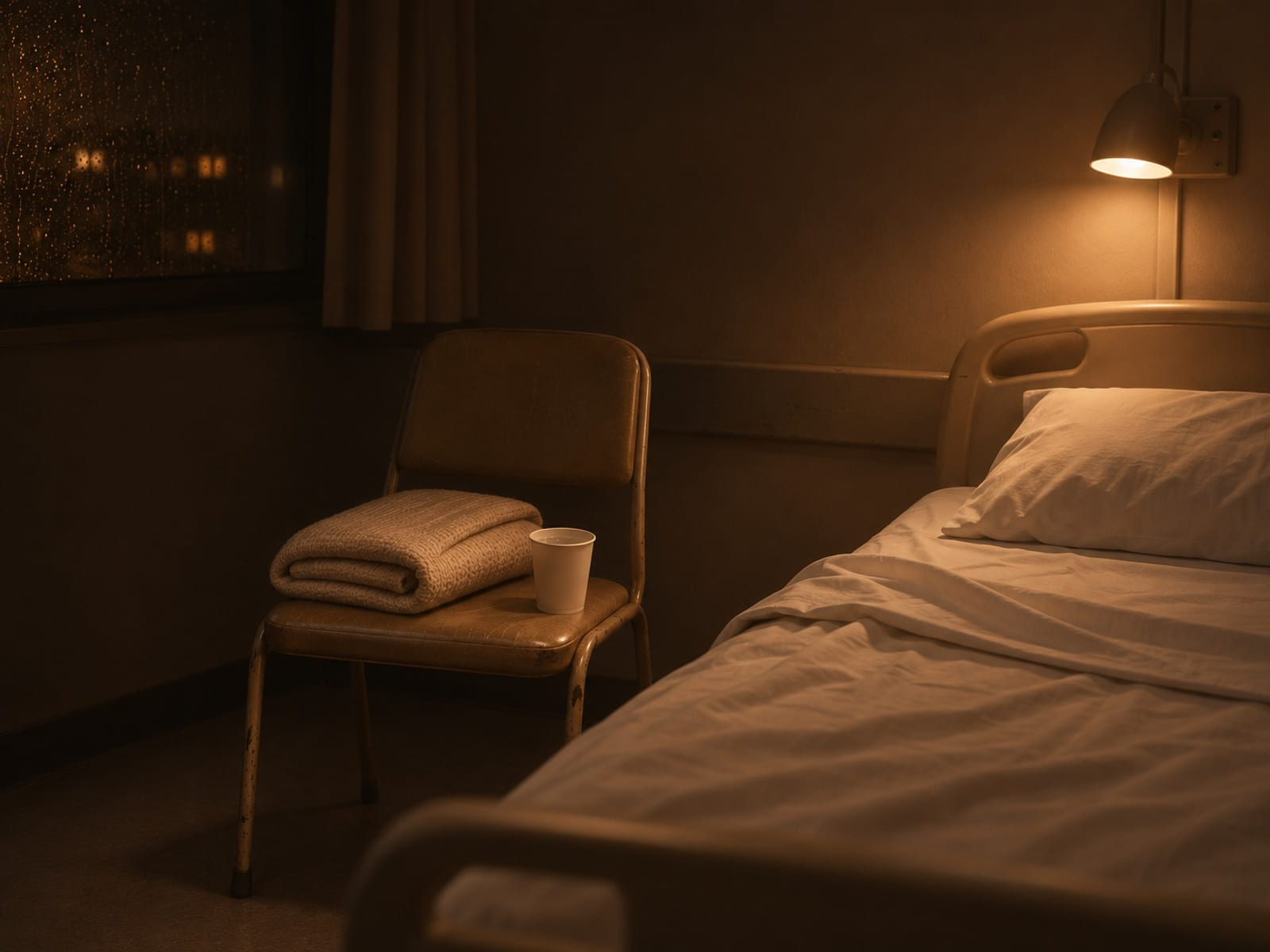
The chair by the bed, kept for whoever stays.
What can you say to someone who is dying?
The words most often pointed to are Ira Byock's four, from his 2004 book The Four Things That Matter Most: "Please forgive me," "I forgive you," "Thank you," and "I love you." In his reader's guide, Byock offers them as a way to tend a relationship and to say love and gratitude while there is time. If you are looking for comforting words to say at a bedside, these four are a plain place to start.
The American Cancer Society and hospice guidance say hearing may remain when a person can no longer respond. That is a possibility, and it is a reason to speak as though they can hear. On Reddit, in r/Catholicism, one person wrote, "You never know how much a sick person hears."
Some families also tell the person that the people they love will be cared for. Marie Curie says this can be reassuring, and that each person and family is different, so say it only if it feels true to you.
For a parent, you might say: "Thank you for everything you gave me. We'll look after each other. I love you."
Which Bible verses can you read aloud at the bedside?
Psalms are read at many bedsides because they were written to be spoken. Read slowly, a few lines at a time, and say the person's name before you begin if you like.
Psalm 23 is read whole at many bedsides. It is a shepherd who leads, feeds and restores, through the valley to a table and a house. In the World English Bible it begins:
1 Yahweh is my shepherd: I shall lack nothing. 2 He makes me lie down in green pastures. He leads me beside still waters. 3 He restores my soul. He guides me in the paths of righteousness for his name’s sake. 4 Even though I walk through the valley of the shadow of death, I will fear no evil, for you are with me. Your rod and your staff, they comfort me. 5 You prepare a table before me in the presence of my enemies. You anoint my head with oil. My cup runs over. 6 Surely goodness and loving kindness shall follow me all the days of my life, and I will dwell in Yahweh’s house forever.
Families who know it in the King James Version may want that wording:
1 The LORD is my shepherd; I shall not want. 2 He maketh me to lie down in green pastures: he leadeth me beside the still waters. 3 He restoreth my soul: he leadeth me in the paths of righteousness for his name’s sake. 4 Yea, though I walk through the valley of the shadow of death, I will fear no evil: for thou art with me; thy rod and thy staff they comfort me. 5 Thou preparest a table before me in the presence of mine enemies: thou anointest my head with oil; my cup runneth over. 6 Surely goodness and mercy shall follow me all the days of my life: and I will dwell in the house of the LORD for ever.
On Reddit, in r/Catholicism, someone answering a question about what to read to a dying Catholic wrote, "Psalm 23 could just be read to me in a loop when I’m dying and I’d be happy." The psalm in its valley verse is also read for the dying person's own fear in Bible verses for fear of death.
Psalm 139:7-12 asks where anyone could go from God's presence, and answers with heaven, Sheol, the far sea and the dark, with God there in each:
7 Where could I go from your Spirit? Or where could I flee from your presence? 8 If I ascend up into heaven, you are there. If I make my bed in Sheol, behold, you are there! 9 If I take the wings of the dawn, and settle in the uttermost parts of the sea; 10 Even there your hand will lead me, and your right hand will hold me. 11 If I say, “Surely the darkness will overwhelm me; the light around me will be night”; 12 even the darkness doesn’t hide from you, but the night shines as the day. The darkness is like light to you.
The same psalm closes with a prayer you can say for yourself:
23 Search me, God, and know my heart. Try me, and know my thoughts. 24 See if there is any wicked way in me, and lead me in the everlasting way.

A low lamp, for reading aloud at night.
What does Psalm 31:5 give, and why is it prayed at the end of life?
Psalm 31:5 is a prayer of entrusting:
Into your hand I commend my spirit. You redeem me, Yahweh, God of truth.
The Hebrew verb behind "commend" is paqad, which means to entrust, or to place in somebody's care. Luke records Jesus praying nearly the same words as his last:
"Father, into your hands I commit my spirit!" (Luke 23:46). Stephen prays words close to it as he is dying: "Lord Jesus, receive my spirit!" (Acts 7:59). The Jewish bedtime Shema carries the same line each night, which you can read about on Sefaria.
What it gives you is words to place the person in God's hands. A family can say them together, or you can say them for somebody who can no longer say them for themselves.
Simeon's prayer to be released in peace, the Nunc Dimittis, begins in the World English Bible:
"Now you are releasing your servant, ... in peace" (Luke 2:29), and it is used in Christian night prayer and funeral settings.
What are Catholic prayers for the dying?
Families who want words already written often turn to the Catholic tradition, which has several. The Catechism names three related practices. The Anointing of the Sick is given by a priest or bishop. Viaticum is Communion for somebody approaching death, which the Catechism calls "the last sacrament of the Christian." The Commendation of the Dying entrusts the person to God.
The Hail Mary closes "pray for us sinners, now and at the hour of our death," and it is prayed at many bedsides, as is the rosary. The Divine Mercy site gives the Divine Mercy chaplet, whose closing prayer asks "that in difficult moments we might not despair nor become despondent." Saint Joseph is named in Catholic devotion as the patron of a happy death, and families pray to him for a good death.
There is no fixed set of three prayers for the dying in the Church. The three most often grouped are the Hail Mary, the Divine Mercy chaplet and a prayer of commendation.
One grandchild, posting on Reddit in r/Catholicism, described the bedside: "As I was praying the fourth decade of the Joyful Mysteries she suddenly and crystal clearly said an entire Hail Mary with me." Another person, in a different r/Catholicism thread on Reddit, was honoring a grandmother's faith: "I am not Catholic, same with the rest of my family, but we want to honor her faith as sincerely as we can."
Orthodox, Anglican, Methodist, Lutheran and evangelical prayers
Each tradition has its own words, and a family can use them as written.
Hover or tap a row to highlight it. Sort by a column heading; a third click puts the rows back in their original order.
| Orthodox | Rite for the Parting of the Soul from the Body; Holy Unction | Orthodox Church in America |
| Episcopal | Ministration at the Time of Death, pages 462 to 465 | 1979 Book of Common Prayer |
| United Methodist | Ministry with the Dying | Book of Worship |
| Lutheran | Orders of commendation: Scripture, the Lord's Prayer, a confession of faith | Your pastor, or your church's service book |
| Evangelical and Pentecostal | Scripture, hymns, prayer together, laying on of hands when welcomed | Your own congregation |
The Orthodox Church in America describes a Rite for the Parting of the Soul from the Body for the time of death. Holy Unction is its sacrament of healing for the seriously ill. A priest may give Holy Communion, read the canon and lead the family. Where a priest cannot come, families pray, read the Psalms or prayers from the service book, make the sign of the cross and call the parish for direction. The Divine Liturgy asks, as the Orthodox Church in America publishes it, "For a Christian ending to our life, painless, blameless, peaceful, and a good defense before the awesome judgment seat of Christ, let us pray to the Lord." A family can say that petition at the bed.
The Episcopal Church's 1979 Book of Common Prayer has a prayer for a person near death: "Almighty God, look on this your servant, lying in great weakness, and comfort him with the promise of life everlasting, given in the resurrection of your Son Jesus Christ our Lord." Its commendatory prayer reads:
Into your hands, O merciful Savior, we commend your servant N. Acknowledge, we humbly beseech you, a sheep of your own fold, a lamb of your own flock, a sinner of your own redeeming. Receive him into the arms of your mercy, into the blessed rest of everlasting peace, and into the glorious company of the saints in light.
Put the person's name where N stands.
The United Methodist Ministry with the Dying has prayers for the dying person and for the family, and a commendation that includes "Lord Jesus Christ, deliver your child N. from all evil and set him free from every bond of sin." Evangelical and Pentecostal churches describe reading Scripture, singing hymns, praying together, laying on hands when welcomed and asking for healing and peace. Where a church has no set rite, the family's own words are the prayer.
Jewish practice, other faiths, and prayer when you are not sure
Jewish teaching on Sefaria describes the Viddui, a confession near death whose wording varies by tradition, and the Shema as the declaration a Jewish person hopes to say at the end. Staying with the dying person so they are not alone is part of the practice. A Jewish chaplain can help a family with all of it, and the National Association of Jewish Chaplains is a place to begin.
For a mixed family, or a hospital that asks, here is a line on each. Muslim chaplains, through the Association of Muslim Chaplains, describe the Shahada, recitation of the Qur'an and supplication. Hindu chaplaincy describes mantra and sacred recitation. Buddhist chaplaincy describes quiet presence and chanting. Each follows the patient's wishes.
If you do not share the dying person's faith, or have none, a hospital chaplain offers presence and listening, with prayer only if asked. On Reddit, in r/hospice, one person wrote, "Personally, I ask for permission to pray." In the same thread another added, "I have had none believers want a prayer in the end days but if they dont ask i dont offer."
You could ask quietly, "Would you like me to pray, or to read something?" When the person can no longer answer, pray silently, or say their name and that you love them.

Many of these hours are spent in a corridor or a waiting room.
What do the last days and hours look like?
It can help to know what the time may look like, in plain words. The NHS says people may lose interest in food and drink, sleep more, grow weaker, breathe differently and become less aware, and that these changes happen to most people at this stage whatever the illness.
Marie Curie describes more drowsiness, eating and drinking less, changes in breathing, talking less, and sometimes restlessness or confusion, and says each person is different. Hospice UK adds changes in circulation and temperature.
A person may show only some of these, and the hour cannot be read from them. The nurse or doctor is the one to ask. At home with hospice, the hospice's own 24-hour number is the one to call at night. Marie Curie also says it is fine for the dying person to spend some time alone, which frees you to eat, sleep and step out.
How do you pray for a peaceful passing?
Many families pray for healing and for peace in the same breath. Traditions say it in their own words.
The Catechism, in paragraphs 2278 and 2279, distinguishes allowing death to come from intending it, and affirms ordinary care. The Orthodox petition asks for "a Christian ending to our life, painless, blameless, peaceful." The Episcopal commendatory prayer asks God to receive the person "into the arms of your mercy" and "into the blessed rest of everlasting peace." Jewish practice includes prayers for peace and the Shema, and distinguishes prayer for relief and a peaceful passing from any intention to hasten death. None of this settles any medical decision, which belongs with the person, the family and the care team.
On Reddit, in r/Christians, one post asked, "Please pray for her healing or peaceful passing and salvation." In r/Catholicism, another person wrote, "I just prayed for God to forgive her for her sins and to take her home when ready."
A prayer anybody can say at the bed: "God, give her peace. Ease her pain. Hold her, and hold us."
What lands badly at a bedside, and what to say instead
You may have heard or said one of these. They usually come from love and from having nothing else to reach for. Each has a gentler line beside it, in our wording.
- "They're in a better place" assumes a belief the family may not share. Try: "I'm here, and I'm staying."
- "God needed another angel" makes a claim about God's purpose. Try saying the person's name and one thing you loved about them.
- "They are only holding on for you" puts the timing on the family. Try: "Stay or step out, whichever you need; both are fine."
- "If you pray enough they will be healed" can turn into blame. Try: "We're praying for her, and we're here whatever comes."
- "Make sure they are saved before it's too late" turns the bed into pressure. Try offering to call their own priest or pastor, if they want one.
Families do not always agree on whether to call a priest or pastor. On Reddit, a poster in r/hospice wrote that "Praying at the deathbed of someone who explicitly does not want that is spiritual abuse." Quietly praying for someone who cannot speak is often accepted, but asking first is kinder.
For the person keeping watch
The passage Bible Nudge offers for caring for someone is Isaiah 40:11. In the World English Bible, with the verse before it:
10 Behold, the Lord Yahweh will come as a mighty one, and his arm will rule for him. Behold, his reward is with him, and his recompense before him. 11 He will feed his flock like a shepherd. He will gather the lambs in his arm, and carry them in his bosom. He will gently lead those who have their young.
Isaiah 40 describes God returning to a people worn out by a long ordeal. The shepherd image covers the flock, the lambs carried in his arm and the ones walking with their young. It gives you a place among those being handled gently while you carry this. Bible verses for cancer caregivers reads the same verse for the long months of caring.
The question to hold is "Who is looking after you while you look after them?" Marie Curie, on rest, food, sleep and breaks, says that a person at the bed may need all of these. Carers UK and Palliative Care Australia write about the strain of caring and the people around you who can help.
If you are far away, or afraid of missing the moment, ask a nurse, a chaplain or a relative to hold a phone to the ear or read a message aloud, and pray from wherever you are. Marie Curie describes dying as individual and warns against assuming a timetable, so, kindly, the timing belongs to nobody at the bed.
On Reddit, in r/Catholicism, someone sitting by an uncle wrote, "This is hard, man. I always thought we would have more time."
Questions people ask
Is "last rites" the same as the Anointing of the Sick? People often say "last rites," but the Catholic Church describes the Anointing of the Sick as a sacrament for serious illness and old age. It can be received more than once. Viaticum is the Communion given as death approaches.
Do dying people hear prayer? Hearing may remain when a person can no longer respond, and hospice guidance treats that as a possibility. Speaking and praying as though they can hear is a kind way to be present.
Can I pray for a dying person who is not religious? Many people ask first, as the r/hospice posters on Reddit above do, and some pray silently. A chaplain can help with presence and listening, with prayer only if the person wants it.
Which saint do Catholics pray to for a good death? Saint Joseph is named in Catholic devotion as the patron of a happy death, and families pray to him for a good death.
Where to go next
For the nights at the bed, these are there to call or read. In the United States, CaringInfo, from the National Hospice and Palliative Care Organization. In the United Kingdom, the Marie Curie Support Line and Hospice UK. In Australia, Palliative Care Australia. In Canada, the Canadian Hospice Palliative Care Association.
If a night gets too heavy, or thoughts of ending your life come, reach a person. In the United States, call or text 988 (988 Lifeline). In Canada, call or text 9-8-8. In the United Kingdom and Ireland, Samaritans is on 116 123. In Australia, Lifeline is on 13 11 14. Anywhere else, Find A Helpline lists services by country.
For the hours after a death, Bible verses for a funeral and what the Bible says about grief are there when you are ready.
Tonight, ask the nurse for the chaplain or call the priest or pastor, then read Psalm 23 aloud once at the bed, saying the person's name. If you want a passage for what you are carrying yourself, describe it to Bible Nudge and it offers one with the verses around it. Find a passage.
Words that come up here
Tap a term to see what it means.
Anointing of the Sick. The Catholic sacrament of prayer and anointing with oil for serious illness or the frailty of old age, given by a priest or bishop.