

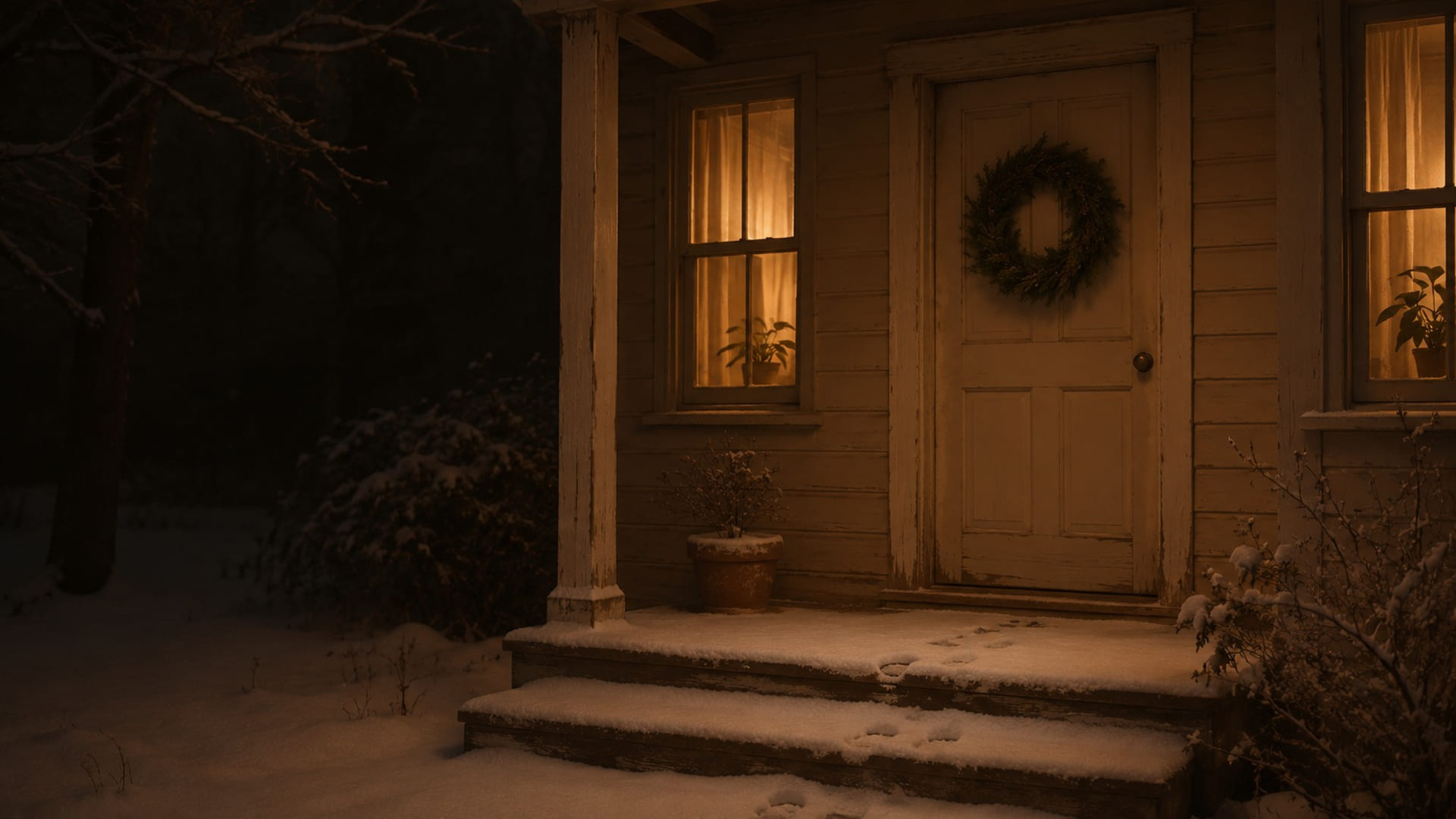
Christmas Eve is Thursday, 24 December 2026, and Christmas Day is Friday, 25 December in most churches, or 7 January in the churches that keep the Julian calendar. If you have been asked to say a few words, here is a prayer you can read exactly as written, from the Collect for Christmas Day in the 1662 Book of Common Prayer:
A collect is a short liturgical prayer that gathers the theme of a day into one prayer. This is traditional wording, free to reuse, and the Church of England prints it on its Christmas Day collect page. One person can read it aloud before a meal or a reading, and nobody else is required to join.
For a table of any belief, here is a plain line of the site's own wording: "Tonight we are glad to be together, glad of the food and the hands that made it, and glad of everyone at this table, near or far. Merry Christmas." If you save only two things to your phone, make them the collect above and this line.
Almighty God, who hast given us thy only-begotten Son to take our nature upon him, and as at this time to be born of a pure Virgin: Grant that we being regenerate, and made thy children by adoption and grace, may daily be renewed by thy Holy Spirit; through the same our Lord Jesus Christ, who liveth and reigneth with thee and the same Spirit, ever one God, world without end. Amen.
If you only have a minute
A prayer to say as written
The 1662 Collect for Christmas Day, above.
For a table of any belief
"Tonight we are glad to be together, glad of the food and the hands that made it, and glad of everyone at this table, near or far. Merry Christmas."
For children, in turns
"Thank you for Christmas, and thank you for everyone at our table."
For family far away
"We are thinking of you tonight and wishing you were here. Merry Christmas, and we will call tomorrow."
What to read from Scripture
Luke 2:8-14, the angels and the shepherds.
For a night that is too heavy
The help lines by country are at the end of this page.
What is the best Christmas prayer, tradition by tradition?
Each tradition below is described in its own words, with a link and a note on whether the text is free to reuse.
The Orthodox Church in America gives this English translation of the Nativity Troparion, and its first sentence reads:
Your Nativity, O Christ our God, has shone to the world the Light of knowledge; for by it, those who worshipped the stars were taught by a star to adore You, the Sun of Righteousness, and to know You, the Dayspring from on High.
The translation is protected, so only that first sentence is quoted here. The OCA page for the Nativity has the rest of the troparion and the Kontakion. The Orthodox greeting for the day is "Christ is born! Glorify Him!", and the reply is "Glorify Him!"
In the Catholic tradition, the Saint Andrew Christmas Novena is prayed fifteen times a day from 30 November through Christmas Eve. It begins, "Hail and Blessed be the hour and moment in which the Son of God was born of the most pure Virgin Mary, at midnight in Bethlehem, in piercing cold." The full prayer is on Saints Encyclopedia. The prayer is anonymous and its origin is told more than one way: one account ties it to an Irish devotional tradition and an 1897 New York imprimatur, and others call its origin undocumented. Its rights status is uncertain, so only the opening is quoted.
Pope Francis wrote a prayerful reflection on the nativity scene in Admirabile signum, dated 1 December 2019. In the Vatican text he says: "Like Saint Francis, may we open our hearts to this simple grace, so that from our wonderment a humble prayer may arise: a prayer of thanksgiving to God, who wished to share with us his all, and thus never to leave us alone." Vatican copyright applies, so it is quoted briefly.
The Episcopal Church's 1979 Book of Common Prayer gives two collects for Christmas Day. The first opens, "O God, who hast caused this holy night to shine with the illumination of the true Light," and the rest is in the 1979 book as a PDF. Church Publishing controls that text, so a brief quotation is all that is given here.
For the Roman Missal, the Lutheran Service Book, Evangelical Lutheran Worship, and the Methodist and Presbyterian books, today's English texts are protected, and they are read in the book your church uses. The Roman Missal has four Christmas Masses: the Vigil, the Mass during the Night, the Mass at Dawn and the Mass during the Day. The USCCB readings page lists the Scripture readings for them.
Which short Christmas prayers are old enough to reuse for free?
If you want something old and beautiful that costs nothing to say, these are for you. Each is quoted exactly.
Phillips Brooks wrote "O Little Town of Bethlehem" in 1868, and the hymn on Hymnary carries its prayer line:
O holy Child of Bethlehem, descend to us, we pray; cast out our sin, and enter in, be born in us today.
Christina Rossetti's "In the Bleak Midwinter," which the Poetry Foundation prints in full, ends by asking what a poor person can give, and answers with the heart.
Both are old enough that anyone may reuse them freely. These give words that already exist to a person who has been asked to say something and has nothing ready.
Howard Thurman's "The Work of Christmas" is a poem for the day after the day. It dates from 1949 and is protected, so it is described rather than printed: it opens "When the song of the angels is stilled" and turns from the manger to the work that follows. The poem is read in full on Howard Thurman's site.
For the table, a second prayer of the site's own wording, to say before Christmas dinner or at a service: "Tonight we light a candle and sit a while. For the people here, for the people far away, and for anyone working or on their own tonight, we ask for kindness and for rest. Amen."
What can you say at the Christmas dinner table?
The table graces that work for any holiday meal, from Catholic and Orthodox to the Selkirk Grace and the Hamotzi, are on Thanksgiving prayer for family, and none is repeated here. What follows belongs to Christmas.
The Polish Christmas Eve supper, Wigilia, begins with the sharing of the opłatek, a wafer, and an exchange of good wishes. An extra place is often left at the table for an unexpected guest. The Diocese of Radom described the custom in 2018, and Catholic Culture connects the empty place with hospitality. What the place stands for differs from one household to the next: an unexpected guest, a traveler, a stranger, the absent. German, Scandinavian, Greek and Latin American Christmas meals each have their own customs too, and a family can keep its own.
Table prayers are usually brief and spoken by the host or another family member. No rule gives the prayer to the youngest, though some families invite a child to say a line.
People ask for exactly this help. On Reddit's r/Catholicism on 25 December 2025, somebody wrote, "Got lots of family coming round for Christmas dinner - most aren't religious. Please, does anyone have any recommendations for a nice grace to say in this context". On r/atheism on 29 December 2025, somebody who tried to say grace at a family Christmas dinner wrote, "Nobody volunteered", and "My food was getting cold!!" And on r/Catholicism on 28 March 2024, a parent wrote on Reddit, "I feel almost embarrassed to pray out loud before family meals with myself, my wife and children present."
The answers below are in the site's own wording. For a mixed table, one sentence with no creed in it: "For this food, and for everyone at this table tonight, we are thankful." Follow it with a moment of silence for guests who would rather pause than say words. For children, in turns: "Thank you for Christmas, and thank you for everyone at our table." For a gratitude round, each person names one thing, and passing is fine.
The Emily Post Institute puts consideration of the person receiving a greeting first. A host can offer "Happy holidays" or "Merry Christmas" where it is welcome, and nobody is required to join a prayer.
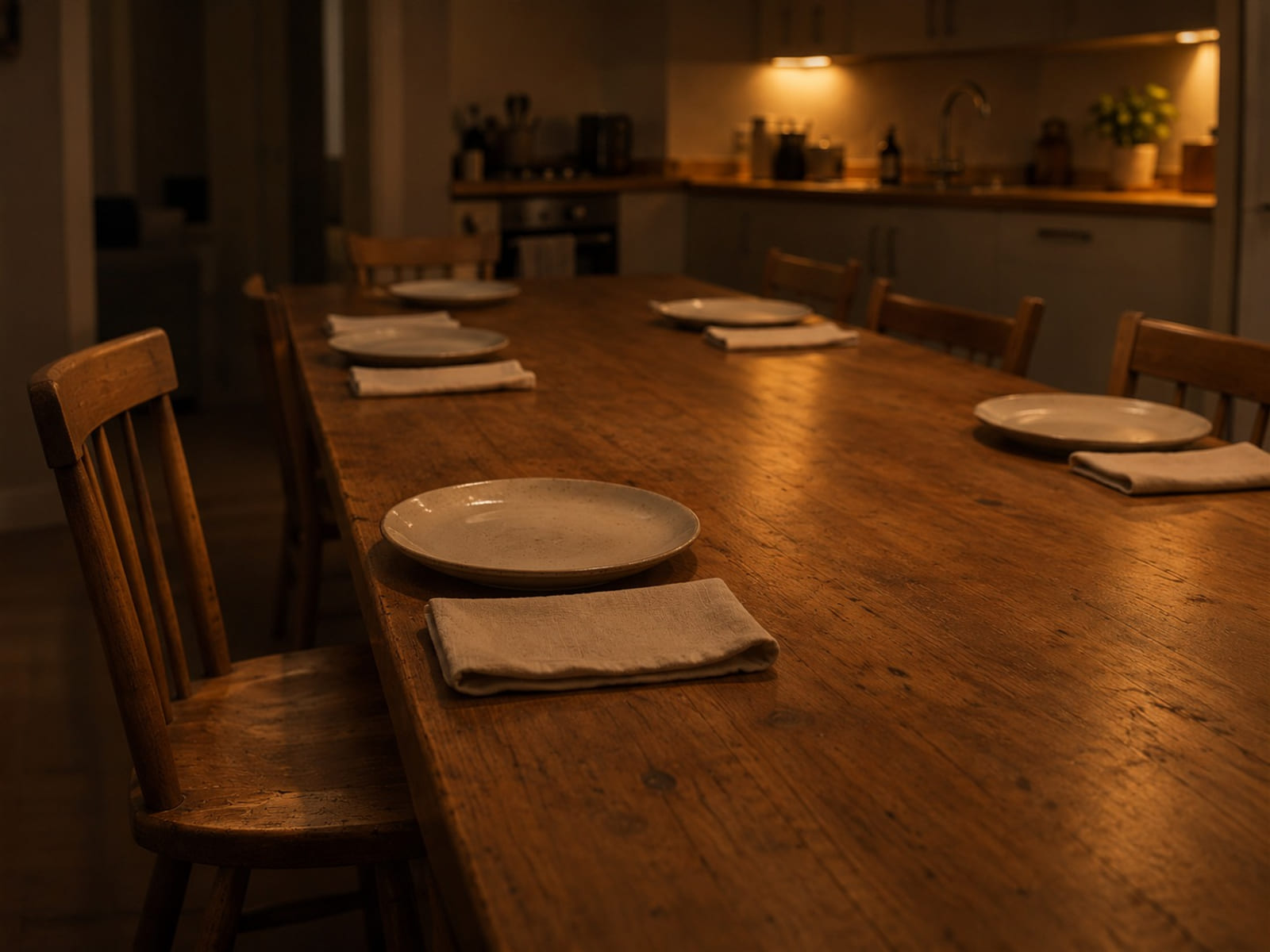
One more place than the number of chairs taken.
What do you pray for family far away, and for people alone or at work?
These are in the site's own wording, and none promises an outcome for any person.
For family far away, a prayer short enough to text: "We are thinking of you tonight and wishing you were here. Merry Christmas, and we will call tomorrow." For a parent whose adult child will not be there: "I am thinking of you today and I am glad you are mine. The door is open whenever it suits you." For children, in turns, the line above works as it is.
For the lonely, said by the person who is alone or by a friend who sends it: "I am on my own today, and I am saying so out loud. Stay near me, and near everyone else who is by themselves. Amen."
For people who work on the day: "For everyone working today, in hospitals, on the roads, at the switchboard and in the station, we are grateful. Be near them, and let them feel thanked. Amen." The Church of England held a Christmas Day service for key workers in 2025, with chaplains, nurses, police and fire personnel taking part. The Archbishop of Canterbury said, "On this Christmas Day I want to extend my thanks to all who are working in the service of others while many of us gather with family, friends and in church to celebrate."
The nativity scene has travelers in it. Admirabile signum says Joseph "did not hesitate to set out and flee to Egypt," which gives a prayer for displaced people a place to begin. In the site's own wording: "For everyone far from home tonight, and everyone looking for a place to stay, we ask for a door that opens. Amen."
If you are the one on your own, these services exist, and each page prints its own contact details:
- United Kingdom: Age UK for older people, and The Silver Line, a free 24-hour telephone service for older people.
- United Kingdom: Crisis at Christmas, run by Crisis for people experiencing homelessness.
- United States: 211, an information and referral service.
- Several countries: the Salvation Army runs Christmas meals and seasonal help, and availability varies, so ask your nearest branch.
On Reddit's r/PrayerRequests on 25 December 2025, one person wrote, "I’m alone. Completely unbearably alone." If that is close to where you are tonight, the prayer for the lonely above is written for you, and the services above and the help lines at the end of this page are there. For grief at Christmas, Christmas when you are grieving is written for that.
Which psalm and which Bible verse should you read at Christmas?
Scripture here answers the question in its own setting. Each text below is given with what it records and what it gives: words to read aloud by candlelight, and a place for the angels and the shepherds in the story.
Luke 2: the shepherds and the angels
Luke 2:1-20 records that Caesar Augustus orders a registration. Joseph travels from Nazareth to Bethlehem because he belongs to David's family. Mary gives birth and lays the child in a manger. Shepherds are in the fields at night, and an angel announces "good news of great joy." Then a multitude of the heavenly host praises God, and the shepherds go, see the child and return glorifying and praising God. The center of it, in the World English Bible:
8 There were shepherds in the same country staying in the field, and keeping watch by night over their flock. 9 Behold, an angel of the Lord stood by them, and the glory of the Lord shone around them, and they were terrified. 10 The angel said to them, “Don’t be afraid, for behold, I bring you good news of great joy which will be to all the people. 11 For there is born to you today, in David’s city, a Savior, who is Christ the Lord. 12 This is the sign to you: you will find a baby wrapped in strips of cloth, lying in a feeding trough.” 13 Suddenly, there was with the angel a multitude of the heavenly army praising God, and saying, 14 “Glory to God in the highest, on earth peace, good will toward men.”
Luke 2:14 is the angels' song, and it is a hymn. The churches sing it in the Gloria in excelsis Deo in Catholic, Anglican and Lutheran worship, and in the Great Doxology in Orthodox worship. The King James Version reads:
Glory to God in the highest, and on earth peace, good will toward men.
The NIV, the NRSV and the New American Bible read it as "peace to those on whom his favor rests." The difference is tied to a Greek variant in the form of the word eudokia, which can mean good pleasure, favor or goodwill, as the NET Bible note explains. Set side by side, neither reading is wrong.
Isaiah 9:6-7: the child and the four names
In Christian numbering the child verse is Isaiah 9:6, and in the Jewish Bible it is 9:5. Both verses follow in the World English Bible, then the King James Version:
6 For to us a child is born. To us a son is given; and the government will be on his shoulders. His name will be called Wonderful, Counselor, Mighty God, Everlasting Father, Prince of Peace. 7 Of the increase of his government and of peace there shall be no end, on David’s throne, and on his kingdom, to establish it, and to uphold it with justice and with righteousness from that time on, even forever. The zeal of Yahweh of Armies will perform this.
6 For unto us a child is born, unto us a son is given: and the government shall be upon his shoulder: and his name shall be called Wonderful, Counsellor, The mighty God, The everlasting Father, The Prince of Peace. 7 Of the increase of his government and peace there shall be no end, upon the throne of David, and upon his kingdom, to order it, and to establish it with judgment and with justice from henceforth even for ever. The zeal of the LORD of hosts will perform this.
The four names are pele yoetz (Wonderful Counselor), el gibbor (Mighty God), avi ad (Everlasting Father) and sar shalom (Prince of Peace). Jewish readers following the JPS translation and Rashi read the passage in Isaiah's own royal and historical setting, as Sefaria shows. Christian worship reads the child and the names as pointing to Jesus. Both readings stand, and each tradition keeps its own. The verses just before these, Isaiah 9:1-2, are on Christmas when you are grieving. Handel's Messiah, first performed in 1742, sets Isaiah's Christmas words to music.
John 1, the psalms and the other readings
John 1:1-14 is the Gospel reading for Christmas Day in the Catholic and Anglican lectionaries. It starts before the manger, with the Word, and arrives at the line about the Word becoming flesh:
1 In the beginning was the Word, and the Word was with God, and the Word was God. 2 The same was in the beginning with God. 3 All things were made through him. Without him was not anything made that has been made. 4 In him was life, and the life was the light of men. 5 The light shines in the darkness, and the darkness hasn’t overcome it. 6 There came a man, sent from God, whose name was John. 7 The same came as a witness, that he might testify about the light, that all might believe through him. 8 He was not the light, but was sent that he might testify about the light. 9 The true light that enlightens everyone was coming into the world. 10 He was in the world, and the world was made through him, and the world didn’t recognize him. 11 He came to his own, and those who were his own didn’t receive him. 12 But as many as received him, to them he gave the right to become God’s children, to those who believe in his name: 13 who were born not of blood, nor of the will of the flesh, nor of the will of man, but of God. 14 The Word became flesh, and lived among us. We saw his glory, such glory as of the one and only Son of the Father, full of grace and truth.
Psalm 96 and Psalm 98 are psalms that tell the whole earth to sing. Isaac Watts paraphrased Psalm 98 as "Joy to the World" in 1719, and the hymn on Hymnary is old enough to reuse freely.
1 Sing to Yahweh a new song! Sing to Yahweh, all the earth. 2 Sing to Yahweh! Bless his name! Proclaim his salvation from day to day! 3 Declare his glory among the nations, his marvelous works among all the peoples.
1 Sing to Yahweh a new song, for he has done marvelous things! His right hand, and his holy arm, have worked salvation for him. 2 Yahweh has made known his salvation. He has openly shown his righteousness in the sight of the nations. 3 He has remembered his loving kindness and his faithfulness toward the house of Israel. All the ends of the earth have seen the salvation of our God. 4 Make a joyful noise to Yahweh, all the earth! Burst out and sing for joy, yes, sing praises!
Titus 2:11-14 is a letter's plain summary of grace, and it is one of the readings used at Christmas:
11 For the grace of God has appeared, bringing salvation to all men, 12 instructing us to the intent that, denying ungodliness and worldly lusts, we would live soberly, righteously, and godly in this present age; 13 looking for the blessed hope and appearing of the glory of our great God and Savior, Jesus Christ; 14 who gave himself for us, that he might redeem us from all iniquity, and purify for himself a people for his own possession, zealous for good works.
Micah 5:2-5 is the passage about Bethlehem, a small town named as the place a ruler comes from:
2 But you, Bethlehem Ephrathah, being small among the clans of Judah, out of you one will come out to me that is to be ruler in Israel; whose goings out are from of old, from ancient times. 3 Therefore he will abandon them until the time that she who is in labor gives birth. Then the rest of his brothers will return to the children of Israel. 4 He shall stand, and shall shepherd in the strength of Yahweh, in the majesty of the name of Yahweh his God: and they will live, for then he will be great to the ends of the earth. 5 He will be our peace when Assyria invades our land, and when he marches through our fortresses, then we will raise against him seven shepherds, and eight leaders of men.
And Matthew 1:23 quotes Isaiah 7:14 and gives the name Immanuel:
“Behold, the virgin shall be with child, and shall give birth to a son. They shall call his name Immanuel”; which is, being interpreted, “God with us.”
The Magnificat, Luke 1:46-55, is the reading for 20 December on What is Advent. It is also sung daily in Catholic Vespers, Anglican Evensong and Evening Prayer, Orthodox Matins and Lutheran evening worship.
Hover or tap a row to highlight it. Sort by a column heading; a third click puts the rows back in their original order.
| Luke 2:8-14 | The shepherds and the angels | A scene to read aloud, with praise in it |
| Isaiah 9:6-7 | A royal child, named four ways | Words for the child, read two ways |
| John 1:1-14 | Gospel reading for Christmas Day | The story from before the manger |
| Psalm 98 | A psalm of singing | The text behind "Joy to the World" |
| Micah 5:2-5 | The small town of Bethlehem | A place in the story |
What can you write in a Christmas blessing or message?
If you want a line rather than a prayer, the Christmas season in the Western churches runs for twelve days, 25 December to 5 January, with Epiphany on 6 January, according to the Church of England. A blessing sent on 28 December is still well within the season.
Greetings in the traditions' own words: "Christ is born! Glorify Him!" among the Orthodox, "Joyeux Noël" in French, "Frohe Weihnachten" in German, "Feliz Navidad" in Spanish, and "Feliz Navidad y próspero Año Nuevo" for Christmas and the new year together.
In the site's own wording, for a card: "Wishing you a Christmas with room in it for rest, and for whatever you are carrying." For a neighbor: "Thinking of you this Christmas. Merry Christmas, and I hope the day is a gentle one." For a mixed group: "Happy holidays, and thank you for this year." For a person who is grieving or estranged, Christmas when you are grieving has what to write in the card.

The kitchen an hour before the guests arrive.
What do you say on Nochebuena, Christmas Eve?
Christmas Eve on 24 December is the center of Christmas in many Spanish-speaking households, and what is prayed that night differs by country. The Misa de Gallo is the Mass on Christmas Eve or at midnight. Colombia's Novena de Aguinaldos is prayed from 16 to 24 December, as Tropicana FM in Colombia reported on 16 December 2025. Both are told at more length on What is Advent, so here is only the prayer part: a family can say the Novena's prayers together on the last evening.
The carol "Noche de paz" began in 1818 with words by Joseph Mohr and music by Franz Xaver Gruber, as the Silent Night archive in Austria explains. Many families sing or hum it as the evening ends.
The same crib scene has different names by country: belén in Spain, nacimiento in Mexico, pesebre in Argentina and Colombia. Each custom is local to its place.
A family can say the Catholic grace before meals in Spanish as the Thanksgiving page gives it, or use the site's own line for Nochebuena, with an English line beside it:
Esta noche estamos juntos, y damos gracias por la mesa, por quienes la prepararon y por quienes no pudieron venir.
Tonight we are together, and we give thanks for the table, for the people who prepared it, and for those who could not come.
What if you cannot feel peace or joy on the day?
You can read this one once, or leave it. The passage Bible Nudge offers for peace is John 14:27, and in the World English Bible it reads:
Peace I leave with you. My peace I give to you; not as the world gives, give I to you. Don’t let your heart be troubled, neither let it be fearful.
Jesus says it on the last evening, after the meal and before the arrest, in one long conversation with a frightened room. The verse sits between a promise that they will not be left on their own and a warning that the world is about to close in. If you want to see John 14:27 with the verses around it, they are there.
What it gives is peace handed over rather than produced, in the present tense, to people who are already troubled and afraid. So, a person who cannot feel Christmas peace has not received it wrongly. Here is the question that goes with it: What would change if peace were something handed to you rather than something you have to produce?
The Christmas peace texts are other texts, Luke 2:14 and Isaiah 9:6, read in their own settings above.
What can land badly at Christmas, and what can you say instead?
Some phrases can wound when they are said carelessly, and each has a better line beside it, in the site's own wording.
Hover or tap a row to highlight it. Sort by a column heading; a third click puts the rows back in their original order.
| "Joy to the world" or "peace on earth" said to somebody in grief or in a divided family | "I know this is a heavy time. I am glad you are here." |
| A prayer that names one faith's savior at a table that is not of one faith | A plain thanks for the food and the people, with each person's own tradition left to them |
| A grace thanking God for a family that is whole, when the family is separated, estranged or changed | "We are thinking of the people who are not here tonight." |
| "The less fortunate," which can turn people into objects of pity | "Everyone who needs a meal or a friend today" |
| "Merry Christmas" pressed on a guest who does not keep it | "Happy holidays, or Merry Christmas if you keep it" |
| "God has a plan for your Christmas," said to somebody who has lost much | "I am here, and I am not going anywhere today." |
Guests describe the hardest moments plainly. On Reddit's r/Jewish on 26 December 2025, a guest wrote, "I did not want to participate in Christian prayers." and "everyone was asked to hold hands." On Reddit's r/exchristian on 21 November 2023, somebody wrote, "My biggest frustration is when they expect me to do 'the prayer'."
A host can prevent both with one habit. Ask the table beforehand which form suits it, offer a moment of silence, let a guest hold their hands in their lap, and never require an Amen. Hands held and heads bowed are customs in some families and optional in others.
If the day is heavy or the home is not a safe one, these routes are by country: the National Domestic Violence Hotline in the United States, Refuge in the United Kingdom and 1800RESPECT in Australia.
Questions people ask
Which Christmas prayer is the one to start with? The 1662 Collect for Christmas Day at the top of this page is traditional wording, free to reuse, and short enough to read from a phone. The site's own line for a mixed table sits beside it.
Who should say the prayer at Christmas dinner? The host or another family member usually does, and no rule gives it to the youngest. If nobody wants to, a moment of silence or a gratitude round works as well.
Does a guest have to join in? No. A guest can sit quietly, hold their hands in their lap or step out for a moment, and a host can say so beforehand.
How long does the Christmas season last? In the Western churches it runs twelve days, from 25 December to 5 January, and Epiphany is 6 January.
Where to go next
Choose one prayer or line above, save it in your phone, and say it before the meal or send it to one person. The neighbors of this page are written for other readers: Thanksgiving prayer for family for table graces, Christmas when you are grieving for grief and the Longest Night, and What is Advent for the season, the wreath, Las Posadas and the Misa de Gallo.
If any night is too heavy, please reach a person. In the United States, call 988, text 988 or use the 988 Lifeline chat; the Spanish page is there too. In Canada, 9-8-8. In the United Kingdom and Ireland, Samaritans is on 116 123. In Australia, Lifeline is on 13 11 14. In Spain, the 024 line. In Mexico, Línea de la Vida. In Argentina, Centro de Asistencia al Suicida. In Colombia, Línea 106 for Bogotá. Anywhere else, Find A Helpline lists lines by country.
Bible Nudge can take a line about what you are carrying, in your own words, and come back with one passage and the verses around it. Find a passage.
Words that come up here
Tap a term to see what it means.
Collect. A short liturgical prayer that gathers the theme of a day into one prayer.