

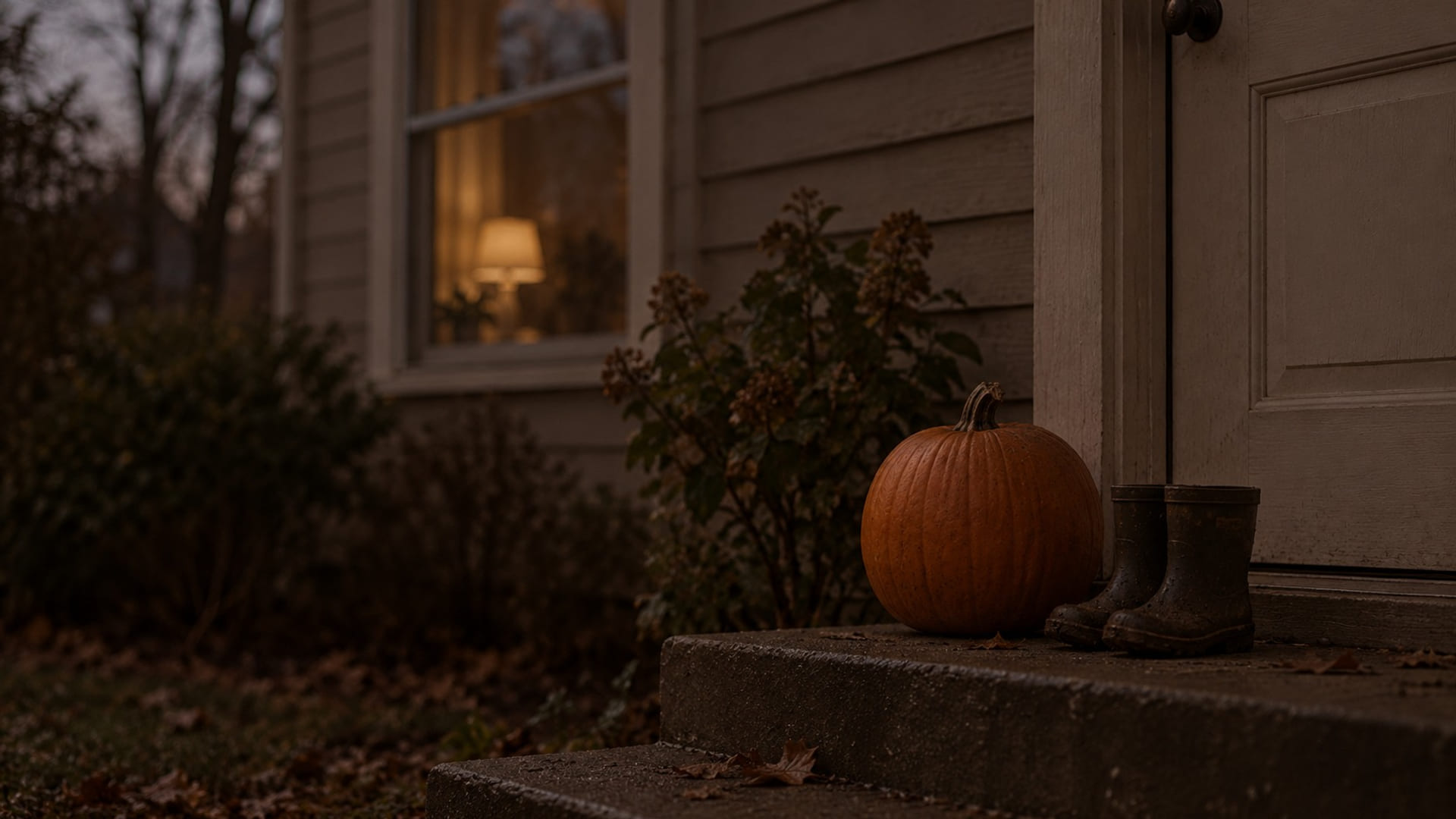
If you have a costume half made or a bowl of candy by the door, and someone close to you has questioned it, you are not doing something wrong, whichever way you decide. Christians in the main traditions have answered this differently for centuries. Nobody is condemned for dressing up, and nobody is lesser for staying home. Below is where each view comes from, so you can decide with your own family and church.
If you only have a minute
For the argument at home
John 14:27, peace handed to you inside the trouble, before anyone has won.
Where Scripture lands
The Bible does not mention Halloween, and people cite it on both sides.
One step before October 31
Name what your household will do or skip, and thank the person who sees it differently.
Words for the argument at home
A disagreement between people who love each other is a trouble of the heart. John 14:27 comes on the last evening before Jesus' arrest, in a room that is frightened, where he names the two things his friends are feeling, troubled and afraid:
Peace I leave with you. My peace I give to you; not as the world gives, give I to you. Don’t let your heart be troubled, neither let it be fearful.
The peace here is handed over rather than produced, and it is offered inside the trouble, not after it. A parent who is unsure does not have to settle the argument first to receive it. Bible verses for peace of mind reads the verse at length. One question to hold: what would change if peace were something handed to you rather than something you have to produce?
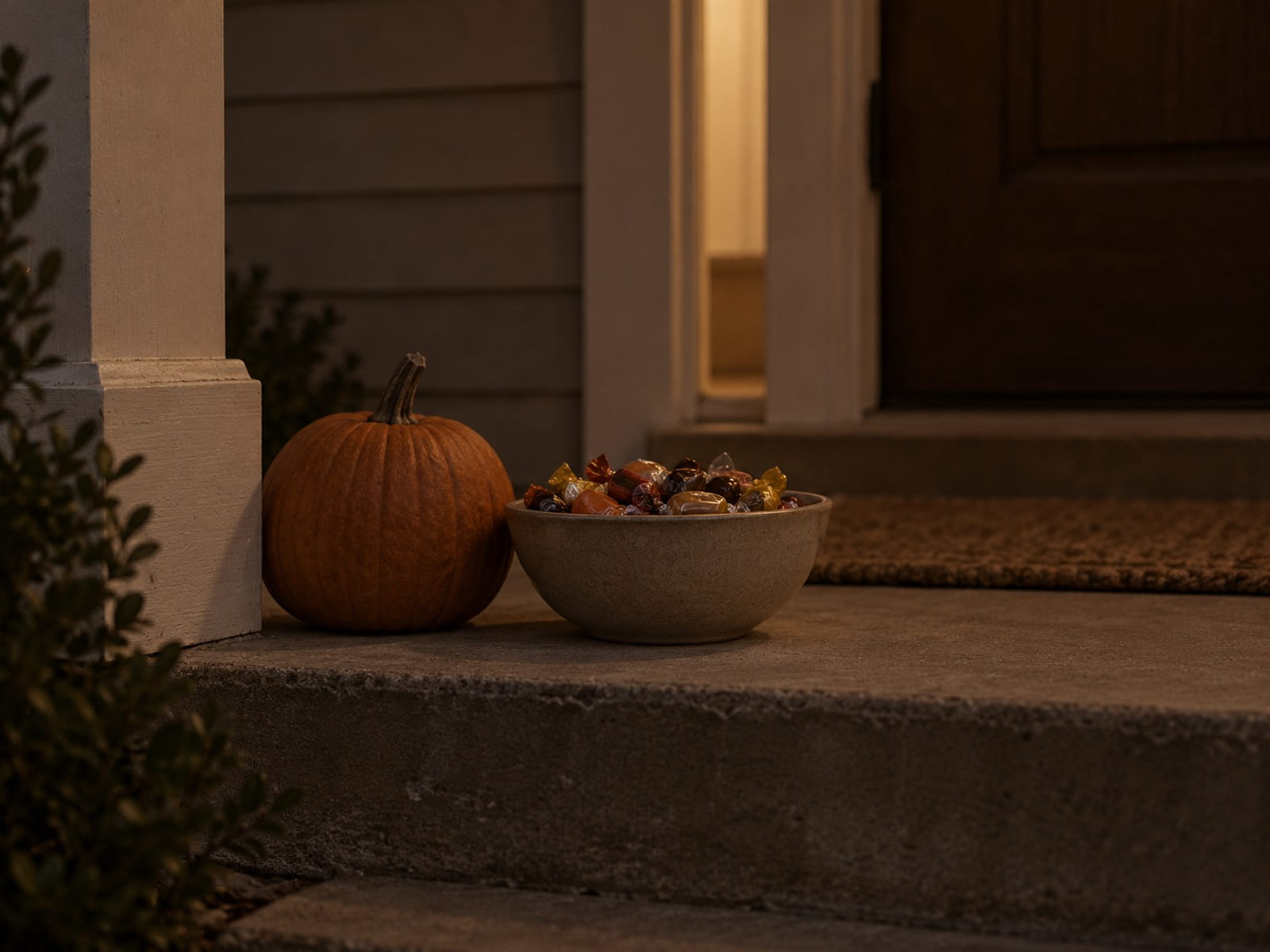
The bowl by the door.
Where Halloween came from
Halloween means All Hallows’ Eve, the evening before All Saints’ Day. The USCCB calls November 1 "the solemnity of All Saints" and November 2 "the Commemoration of All the Faithful Departed." Encyclopaedia Britannica describes Samhain as "an ancient Celtic festival marking the end of summer." Historians disagree on how the two connect. Ronald Hutton, in The Stations of the Sun (1996), disputes that Halloween is simply a Christianized Samhain. Nicholas Rogers, in Halloween: From Pagan Ritual to Party Night (2002), describes layers of Christian observance, older seasonal custom, and later Irish, Scottish and North American tradition.
In souling, poor people received soul cakes for prayers for the dead. Guising, children in disguise visiting houses, belongs to Scotland and Ireland. Trick-or-treating became widespread in North America in the twentieth century, according to the Smithsonian and the Library of Congress. In the United States alone, the National Retail Federation projected $13.1 billion in 2025 spending, with 73 percent of consumers planning to celebrate.
What Scripture records on each side
The Bible does not mention Halloween, so both sides reach for passages written for other settings.
People who avoid the festival often cite Deuteronomy 18:9-14, where Israel, entering the land, is told "you shall not learn to imitate the abominations of those nations," and divination, consulting a familiar spirit and necromancy are named. Leviticus 19:31 and 20:27, on mediums, sit in Israel's holiness laws. Galatians 5:19-21 lists sorcery among the deeds of the flesh, and Ephesians 5:11 says "Have no fellowship with the unfruitful deeds of darkness." Sefaria reads Deuteronomy 18 as Israel's rejection of divination and necromancy within its covenant, and the Catechism of the Catholic Church (2115 to 2117) treats divination and magic as incompatible with trust in God.
People who take part often cite Romans 14:1-6, a dispute among believers over days and food, where Paul writes "Let each man be fully assured in his own mind." They also cite 1 Corinthians 10:23-33, on conscience; Colossians 2:16-17, "Let no one therefore judge you in eating, or in drinking, or with respect to a feast day"; and Acts 17, where Paul in Athens uses local religious language and the altar "TO AN UNKNOWN GOD." Reformed commentators commonly read Romans 14 as a disputable matter, and Catholic commentators connect it with conscience and charity.
Some who abstain draw the line at occult practice and not at costumes or candy, while others hold the imagery too close. Both readings stand here.
How churches and groups treat it today
- Catholic. Catholic Answers calls Halloween "the vigil of the feast of All Saints." In the United States, November 1 is a Holy Day of Obligation unless it falls on a Saturday or Monday; the rule differs by country.
- Orthodox. The Orthodox Church in America keeps All Saints on the Sunday after Pentecost. Its reflection All Saints or Halloween (2010) says "‘Hallow’ is an ancient form of ‘holy,’ and ‘een-even’ means ‘eve,’ thus Halloween is the eve of all saints."
- Lutheran. The Lutheran Church-Missouri Synod keeps October 31 as Reformation Day, the date of Luther's Ninety-Five Theses in 1517; congregations differ on festivals.
- Latter-day Saints. Members commonly join ordinary community activities.
- Focus on the Family (published 2025-09-17) answers, "Can Christian parents celebrate Halloween? Yes," with the decision resting on how a family celebrates.
- Answers in Genesis (published 2025-10-11) writes, "The Bible forbids attempting to communicate with the dead, witchcraft, and worshipping Satan," and treats candy as a matter left open.
- GotQuestions says, "Due to its decidedly pagan origins, the answer to the question as to whether Christians should celebrate Halloween is a resounding no," and in the same article that an innocent costume and asking for candy are not themselves evil.
- Jehovah's Witnesses say they do not celebrate it.
What people say at home, and a better line
One parent posted on Reddit, in r/Christianity on 2026-10-01, that "Last Sunday, my wife's pastor told her that she shouldn't be celebrating Halloween. No parties. No passing out candy. No decorations. Something something demons." Another person in that Reddit thread answered, "I also donate trick-or-treat buckets to my local pantry. Can't tell me that's evil."
A husband wrote on Reddit's r/Christian in 2019 that he was never allowed to celebrate, and his wife "has not reacted kindly to this". Someone on Reddit's r/exchristian wrote in 2022, "I still have trouble feeling like Halloween isn’t full of evil."
"Halloween is the devil's holiday," posted on Reddit's r/Christianity in 2020, lands badly because it turns a family choice into a verdict. Words like "bad Christian," "lost" and "worldly" are heard against "growing up," "fun" and "candy." Three lines in the site’s own wording follow. "I'd like us to decide this together, and I want to hear what worries you." "We can pass out candy and skip the scary part, or skip it all; either way we are the same family." To a teenager: "Tell me what you love about it."
The person at home who sees it the other way is usually protecting something they love. A household can look for what both want, such as a church harvest night, a porch light and candy, or a quiet evening, without either person being proved wrong.
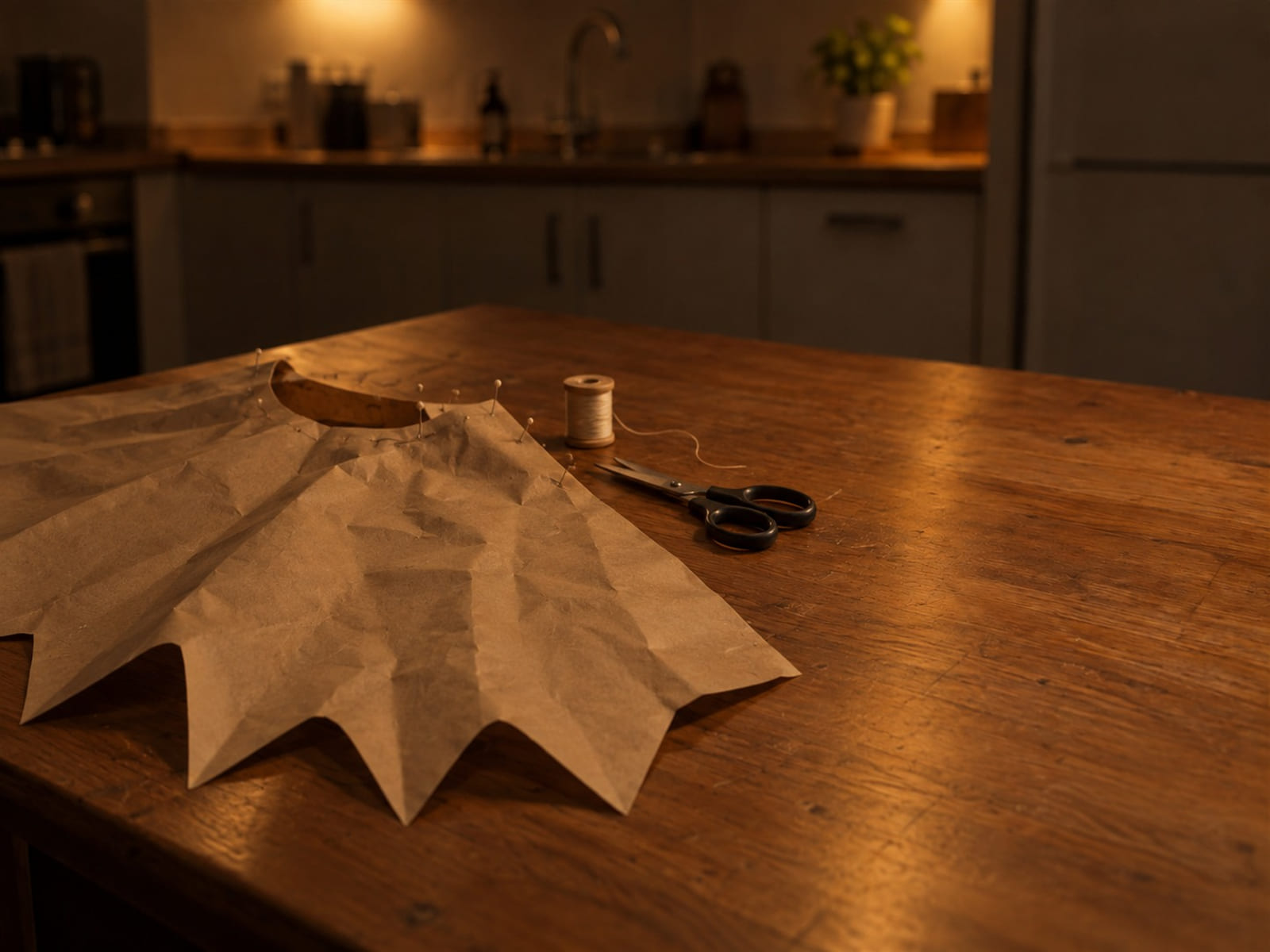
A costume in progress.
Beside the argument
Protestant churches commonly hold trunk-or-treat events, harvest festivals, "hallelujah nights," light parties, All Saints parties and Reformation festivals around October 31, and the United Methodist Church has described some as Halloween alternatives; congregations differ. For readers from Latin American families, Día de Muertos is its own observance. UNESCO describes it as commemorating "the transitory return to Earth of deceased relatives and loved ones" on November 1 and 2, kept with altars, photographs and family remembrance.
For the practical side, the American Academy of Pediatrics covers costume fit and masks, and the National Safety Council and NHTSA cover night walking and driving. In the UK see RoSPA, in Ireland the Road Safety Authority, in Australia Kidsafe. KidsHealth notes that children differ in what they find frightening. One idea of our own: let the child set the limit.
Questions people ask
Is Reformation Day the same as Halloween? No. Both fall on October 31, but Reformation Day is kept especially by Lutheran and Reformed churches, and All Saints follows on November 1.
Where to go next
Before October 31, name the one thing your household will do or skip, tell the person who sees it differently one thing you appreciate about how they care for your family, and read John 14:27 once, aloud, with the question above. Bible Nudge gives a person one passage with the story around it, and Find a passage is where to start.
If any night feels too heavy, whatever the reason, please reach a person. In the United States, call or text 988 for the 988 Suicide and Crisis Lifeline. In Canada, call or text 9-8-8 at 988.ca. In the UK and Republic of Ireland, Samaritans is on 116 123. In Australia, Lifeline is 13 11 14. Anywhere else, Find A Helpline lists lines by country. Emergency services are 911 in the United States and Canada, 999 or 112 in the United Kingdom and Ireland, and 000 in Australia.
Words that come up here
Tap a term to see what it means.
All Hallows’ Eve. The evening before All Saints’ Day. "Hallow" is an old word for holy.